A Lot To Digest
Thanksgiving is a couple of weeks away, yet this weekend we have a lot to digest.
Neither the polls nor prediction markets did a great job preparing markets for the midterm results. As far as I could tell, the “whisper” number was that the polls were off, and the Republicans would do better than the polls predicted (which has typically been the case since DJT started running for office). It turned out that they were off in the other direction, so markets and D.C. are busy trying to figure out:
- What does this mean for the next few weeks/months until the newly elected officials are sworn in?
- What does this mean for Q1 and Q2 once the newly elected officials have settled in?
If markets weren’t having so much difficulty assessing the post-election landscape, we wouldn’t have to look at a chart as volatile as this:
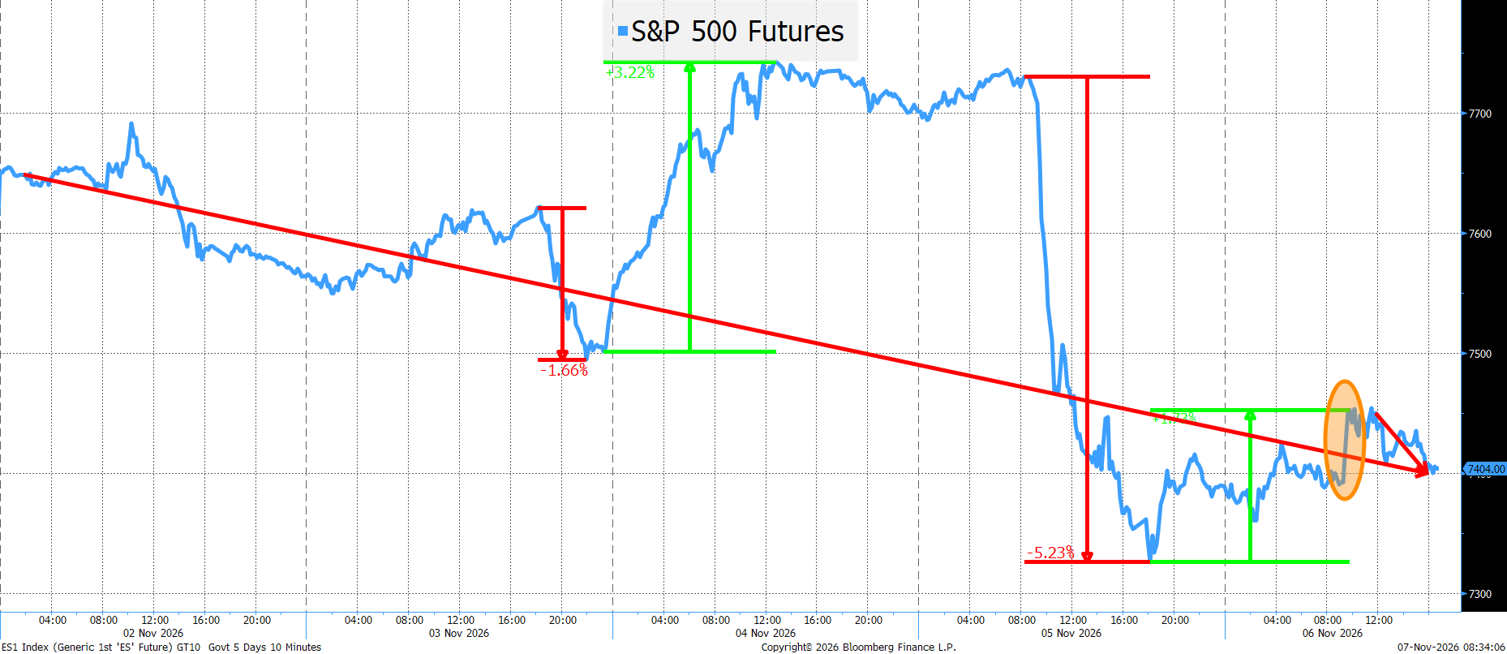
All major U.S. indices were down on the week and finished by limping into the close (Japan was hit very hard (11% down), but most European markets and Canada inched higher, with the one-month global outperformance even more apparent). We continue to believe that as the rest of the world embraces ProSec™ (Production for Security), the global growth story will provide investment opportunities.
Jobs Data
We didn’t get to comment on Friday’s “amazing” jobs data, the little orange oval. Partly because it didn’t do much to markets (nor should it, since whatever has been happening pre-election needs to be re-analyzed and re-considered), and partly because I am losing faith in these things being even remotely accurate except for longer-term averages. Virtually every part of Friday’s report showed not only a strong labor market, but also one that was stronger than we all thought a month ago when we got the “punk” report, which we spent more time questioning than analyzing last month. Please see Can We Admit This is Just Absurd?
- The JOLTS Quit Rate (which I like as a “crowdsourced” dataset) increased to 2.1 from 1.9, the first time it has been that high since June 2025, which is good. On the other hand, 2.1 is still very low, indicating those with jobs don’t feel overly confident about their prospects of getting a new, better-paying job.
- The underemployment rate went from 7.6% to 7.9%, which seems odd given how strong the rest of the report was.
- The Birth/Death Model was 412k. That is similar to last October’s 413k, but I’m highly skeptical of the data collection process of the entire report, and think the analysis of how many jobs were created by new businesses, versus job losses from businesses closing down is particularly bad. This doesn’t feed on a one-to-one basis into the NFP report, but I cannot say it gives me a lot of comfort that we can’t have revisions in the other direction next month.
A New Chief of Staff
We have been arguing that how the winners and losers respond will be as important as, or more important than the results themselves.
Initially both sides seemed to be playing in the sandbox as nicely as possible.
Friday’s announcement that Stephen Miller will be the new White House Chief of Staff may make markets question whether there is any willingness to work together, as he has been one of the staunchest supporters of policies that, from my point of view, seemed to drive the electorate in the other direction.
We will see, but I think markets should hunker down for more volatility rather than less as the aftermath of the election results sorts itself out.
Our Current Take
Rather than rehashing what we’ve already written or posted, let’s just point you to what is already out there:
- Friday’s SITREP: S. Ready To Strike Iran. Academy’s Geopolitical Intelligence Group weighs in on the Iran situation with all of the current information we have on hand. While CENTCOM is ready to act, it appears, at least for the time being, that the Vice President’s efforts toward a deal will continue.
- From Thursday, the latest T-Report, Election Implications: Iran, Trade, Compute Spend, and Affordability. Please read the full report for details on the subjects discussed.
- Iran dovetails with the SITREP.
- On trade, I may be overly optimistic, but I think we could see some veto-proof legislation as early as Q1 to get a more focused tariff strategy: tariffs that would focus on competitors and fix some areas where the tariffs have been harmful to America’s efforts to build compute and re-industrialize, and particularly harmful for the agricultural industry. There is even a chance some deals are struck, negating the “necessity” (in my view) of having a more thoughtful approach to tariffs.
- On compute, I think we are just entering a “new era” where the entities doing the build-out will have to do a better job of community outreach, something we’ve been arguing in favor of the entire year. Some states and regions will step up and embrace compute build as an opportunity, while other states and regions will require convincing. As higher latency becomes acceptable, the locations of data centers and what they will look like will continue to evolve. Stav Gaon has produced a body of work getting more granular on many of these subjects. While space might be the future of AI or SI (Super Intelligence) or, more recently, DI (Digital Intelligence, which I like better than SI), I think there is plenty of room for terrestrial AI. 😉
- Affordability could be positively impacted by the next steps with Iran, and possibly with Russia and Ukraine (though don’t expect any major breakthroughs until after the winter, which Russia views as being to its advantage in terms of gaining leverage on and off the battlefield). Anything on trade that represents my view on “thoughtful and targeted tariffs” would greatly help affordability. Finally, as the compute build evolves, we might see some burden shifting, and any slowdown versus current projections on the spending pace could reduce price pressures on the entire AI ecosystem (from chips, to copper, to construction crews).
- Bloomberg TV allowed Academy to guest host an hour on Wednesday after the election. It’s been a long time since I’ve been that nervous, but we had some great guests from MS, PGIM, and Schroders to talk to, as well as to express our own takes. Bloomberg TV starts at the 1-hour, 44-minute mark and plays until the end; we even get the last word (for better or worse).
- On Thursday, from Louisville, as markets were getting hit hard, we got the opportunity, again on Bloomberg TV, to express our ongoing concerns about the “mechanical pressure” on the tech sector more broadly, and the chip sector more specifically.
- We get to kick off the week bright and early on CNBC on Monday. Friday’s “rather feeble” rebound and “limping into the close” don’t give us a lot of confidence that we have bottomed yet.
If you missed any of the reports sent by Academy this week, now is a good time to catch up.
Bottom Line
Credit spreads are key. By almost any metric you can think of, credit outperformed equities this week, in a meaningful way. We need the credit markets to remain targeted and orderly to establish a base for equities to bounce. We see normal price discovery in sectors that are not currently being hit, and even in the sectors that are being hit, the trading seems to be “orderly.” We continue to watch for cracks (especially as we remain cautious on risk), but so far, we aren’t seeing the sort of cracks in credit that would destabilize equity markets more broadly. The risk that this occurs has not gone away, but it is very encouraging that credit is so well behaved (like a child who still has Halloween candy left this week; the child was probably a bit naughty, but demonstrated some solid self-control).
Treasuries are lower down on my radar screen as something to drive other markets than they have been in some time. Treasuries, currently, are more reactive than proactive (or predictive). Given my outlook on affordability and the risk that financial conditions tighten further, I have to be at least mildly bullish on Treasuries. Markets are pricing in fewer than 2 hikes between now and this time next year. That is more in line with my views, but I believe that by January the market will be pricing in cuts for 2027.
I am watching technicals more than usual, primarily because in times of turbulence more investors than normal look to technicals for guidance. Much like ancient cultures found all sorts of explanations for thunderstorms, earthquakes, or volcanic eruptions, market participants tend to gravitate to technicals when we are outside of our “comfort zone.” Also, no one seems to think about the “mechanical nature” of leveraged ETFs when stocks are going higher (then it is all “fundamentals”), but the mechanical nature, stop losses, etc., all pushed the AI/semi trade to highs during peak “Situational Awareness” brilliance. When we think of valuations today versus the highs, it is worth at least questioning whether the highs were realistic or not. Not a bad time to revisit our Situational Unawareness piece that contextualizes the up move and the down move, which culminated in a “rescue” of the Situational Awareness fund.
The Anthropic IPO will be on everyone’s radar screen. What is the valuation? How much money will be raised? The details on the Anthropic IPO will have implications for the broad market (and economy) as it will help everyone hone their compute spend narrative.
I think we will see more selling pressure this coming week:
- Buying the dip was alive and well. Despite the selling, we had enough bounces and buying the dip to convince me that we have not seen capitulation or a “flush out” of risk-taking.
- Unlike after Liberation Day, or during this summer’s apparent unwind of some funds, I’m not sure the current market turbulence is as easy to turn around:
- Seeing political friction turn into animosity is a real risk that markets are currently not pricing in.
- Technical levels are not supportive for either the semis or the broader tech market, which is not good for the overall market (or the economy).
- While I think we will have some positive results around the major issues, those positive results will likely take weeks or months, so won’t be fast enough to rescue the market.
- I’m more worried that some of what seems to be forced selling in equities hits credit, which will not allow equities to bounce.
Longer term, I think we will be in a position to see more growth and higher equities. For now, I’d rather be overweight globally than domestically. Domestically, a focus on those companies and industries that will benefit from an admin that relies less on tariffs as a key policy tool makes sense, but again, relief there seems likely to occur only after the new representatives are sworn in.
A lot to digest, and this week, please remember our veterans and all those who served our country. It is also important to note that November 11th is celebrated not only in the U.S. as Veterans Day, but also across many countries as Remembrance Day. The 11th hour of the 11th day of the 11th month is historically important and gives me a lot of hope that we can achieve ProSec™ while working closely with those who have similar visions of freedom and peace.