Academy SITREP – U.S. Ready to Strike Iran
What has Happened:
- As we have addressed in our recent ATW, podcast, and T-report, we believe the U.S. is ready to strike Iran and intends to do so in the coming weeks, and possibly even sooner.
- While a final decision has not been made, U.S. Central Command (CENTCOM) is finalizing operational preparations for a potential resumption of major strikes.
- Indirect, Qatari-mediated peace talks between the United States and Iran are currently taking place, but there has been little to no progress made as Iran is stuck on its seven core demands.
- The U.S. position includes Iran providing the International Atomic Energy Agency (IAEA) with access to damaged facilities and capping its highly enriched uranium stockpile.
- Iran demands immediate sanctions relief and a lifting of the port blockade first, proposing to push discussions around the nuclear program to a secondary phase of talks.
- The U.S. carried out limited, defensive strikes on Iran’s Qeshm Island on Monday, November 2, after the Islamic Revolutionary Guard Corps (IRGC) fired on a U.S. aircraft.
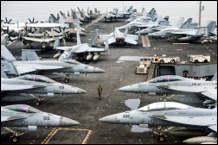
- The U.S. maintains a massive presence capable of striking at any time, including two Carrier Strike Groups and one Amphibious Ready Group in the Arabian Sea, with a third Carrier Strike Group (the USS Theodore Roosevelt CSG) and a second ARG currently en route to the Middle East.
- These new assets should be on station by the second or third week of November, but the U.S. has plenty of capabilities already in theater to act before the additional forces arrive.
Why it Matters:
“Despite the midterms and their results, nothing has fundamentally changed in our strategic challenge with Iran. A significant gap remains between America’s overwhelming military superiority and our ability to compel Tehran to meet our demands. CENTCOM has developed plans for follow-on strikes and is ready to execute them (that’s their job), but Presidential approval is not a foregone conclusion. As the administration weighs options for another round of punishing airstrikes, they must consider what these might deliver that eight months of economic pressure, maritime interdiction, and Operation Epic Fury did not. They must also ask whether economic pressure can eventually break the regime and, if so, whether we have the patience to withstand higher oil prices until it does. They may also debate whether to accept a narrower, more attainable definition of victory than the one outlined back in February, but at a minimum we must restore maritime security and freedom of navigation and prevent an Iranian nuclear program. While Iranian leaders publicly celebrate the success of their Hormuz pressure campaign, Tehran must face the fact that a flip in House and Senate leadership does not fundamentally change America’s posture toward Iran. Here are three indicators to watch: details of Iran’s latest nuclear proposal, reportedly submitted yesterday (what substantive concessions, if any, does it contain?); Iranian actions in the Strait of Hormuz (do they back down on harassment and interdiction now that the election is over?); and atmospherics from Omani and Qatari mediation efforts (does Iran appear more flexible, or are we facing continued intransigence?).” – General Karen Gibson
“For the next 58 days, President Trump will be focused on driving one of three end states prior to the seating of the next U.S. Congress in January 2027, which will hold the power of the purse and authorization to use force. These end states include, in preferred order, escalation paired with increasing economic pressure to force a deal, settling into a long-term sustainable blockade with periodic strikes, or unilateral withdrawal based on a narrower definition of victory. All three require time, particularly if less-desired options follow unsuccessful attempts at the preferred outcome. With talks ongoing but substantively going nowhere, the President is potentially best served by acting earlier than expected to maximize what can be achieved in 58 days. Most media suggest the timing of kinetic actions will coincide with the arrival of the USS Roosevelt in mid-to-late November; the reality is all U.S. actions under consideration can be conducted with the existing two carriers and deployed air, ground, and seapower. The forces are prepared, re-armed and ready, and U.S. escalation as early as this weekend or next week should not be discounted. Iran will of course respond against U.S. forces and one or more regional nations. U.S. operations that are intense but limited to nuclear, missile, and drone sites and do not include infrastructure could result in a shorter or less severe Iranian response, which could be a signal of readiness for potential negotiations.” – General Jeff Kruse
“I remain of the view that the U.S. will resume combat operations against Iran within the next several weeks. As has been observed, negotiations, such as they are, have been unproductive. The midterm elections have passed and the domestic political damage has been done. There will be, I think, a desire on the administration’s part to force some satisfactory conclusion, whether in the form of an acceptable settlement, unlikely in my view, or a manageable exit strategy, before the incoming Congress can hold funding hostage. Either case will require, I think, a renewed round of intense military activity. As previously discussed, I think creating a militarily weak, and economically devastated, Iran capable only of sporadic nuisance actions, and still subject to sanctions and blockade, is the likely near-term outcome. This is one of the rare conflict areas where time works in our favor. It would be unfortunate if we completely walked away.” – Neil Wiley, Former Principal Executive in the Office of the Director of National Intelligence
“I would be very cautious about trying to time any future near-term U.S. kinetic strikes against Iran. It is unclear that President Trump has definitively decided on a course of action. Likely weighing heaviest on his decision-making calculus is what exactly will be achieved by kinetic action. Will this increase the likelihood of the Iranian regime reaching an agreement with the United States that meets our core objectives as related to Iran’s nuclear program and free and unfettered transit through the Strait of Hormuz? Alternatively, will this increase the likelihood of significant Iranian retaliation against its Gulf neighbors that leaves the region worse off than if the U.S. stayed the course with the ‘Bessent approach’ to economically strangling Iran? And how critical is it to take action against Iran before the Democratic Congress is seated? President Trump is likely exploring answers to these fundamental questions and weighing a series of options, none terribly appealing either from a domestic political or international geopolitical perspective. Therefore, the timing of U.S. kinetic action is very hard to predict.” – Joe Zacks, Former CIA Deputy Assistant Director for Counterterrorism