Election Implications: Iran, Trade, Compute & Affordability
Post-Election Thoughts
Academy had the privilege of guest hosting on Bloomberg TV yesterday morning between 8 and 9 am. Our segment starts at the 1 hour 44 minute mark and goes to the bitter end. 😊 It was all fresh at the time, and we were all trying to digest what the election meant. It might be more difficult asking questions than it is answering questions! But we covered a lot of ground and continue to work on our views on what this means going forward. We will quickly cover 4 here (using only 3 subsections). The Iran War. Trade and Tariffs. The AI “Revolution.” Affordability is an outcome of each section.
The Iran War
As you’ve heard in our recent podcast or read in our latest Around the World, the current situation is more or less this:
- The blockade has been very successful in slowing Iran’s oil sales to a trickle. There is very little if any Iranian oil still at sea. The lifeblood of their economy has been hit hard (this has had the consequence of keeping oil prices and all other variations of energy products higher than they would have been otherwise).
- Sanctions should be further choking their economy. The success of the blockade is more readily visible than the impact of sanctions/sanction enforcement (the latter being more important), but the increased effort seems real and should be impacting their economy.
- The U.S. has more than enough resources/troops already in the region to launch full-scale attacks and more resources/troops are on the way. The elections in Israel also seem to have given them the green light to proceed with another escalation.
- The U.S. elections set the stage for the administration to make a bigger push sooner rather than later, while the Republicans still control both the House and the Senate.
Our GIG expects another attempt to escalate to force a deal this month. General Bellon from our GIG believes it could happen soon, especially if the negotiations fall apart in the next week or two.
- Will the deal be better than the MOU that was signed in June? Very likely.
- Will we see real regime change? Not likely.
- Will the U.S. have to maintain a significant military presence in the region during and after negotiations to finalize the deal? Extremely likely.
- During negotiations to finalize the deal, will there be additional attacks by both sides? Very likely.
Expect some “bumps” along the road (increases in energy prices), but we see a path back to some form of truce, while negotiating the details (yes, a lot like during May and June), by December. Far from a perfect outcome, but it should be an acceptable outcome at this stage. How good it is really depends on how much Iran negotiates in good faith rather than just biding time. Between the last time we were “negotiating” and this time, Iran should be closer to truly negotiating, but only time will tell. In the meantime, this is my base case for energy prices (and therefore affordability linked to energy prices).
Oil prices can “normalize” quickly, diesel (and fertilizer) will take months, and LNG from the region will take even longer than that.
The elections were a “forcing function” to drive the next month or two of action on the U.S. side.
Trade and Tariffs
If there is one piece of legislation with enough bipartisan support to be “veto proof” it could be related to trade and tariffs.
Tariffs did impact affordability. Some of the regions that “turned” blue were in states where agriculture plays a big role. Diesel is important but so is fertilizer. Also, in general, good trading relationships help us export and many trading relationships have been “strained” (to put it mildly). Also, along the borders where autos play a big role, the map is colored blue. Maine too?
In a “perfect” world (or what I would recommend doing, which for now, we will pretend is “perfect”) the legislators who want change could use AI (or people) to do the following:
- Identify resources (including processed, smelted, and refined resources) that the U.S. needs for agriculture, and to build out energy production, the grid, and compute (we could look for more areas of need, but this is a good starting point).
- Identify for which of those resources we rely on significant imports.
- Realistically assess how quickly domestic production can be ramped up to replace such imports.
- Prioritize which countries we import from by geopolitical threat risk, with those we are closest with having the highest priority.
- For those resources that we need, we import heavily, and we cannot quickly ramp up production, let’s remove trade barriers with those countries closest to us, while being more cautious on countries that we are increasingly concerned about (but even then, we might need to engage in trade, just with eyes wide open to the longer-term risks).
- We might need to implement barriers over time, so domestic sources can be ramped up, and that is fine. A 5-year plan would be great.
- We might need direct government investment to get some of those domestic sources the jumpstart they need, which is also fine.
- Identify for which of those resources we rely on significant imports.
Yes, I’m known as “Mr. Potash” at Academy Securities, and I think that is a resource that would make it through my filters. Aluminum too. The list of resources that we need, we cannot ramp up production quickly for, and we have tariffed (thus stymying our own economy) is long, but that would be a great bill to get a “veto proof” piece of legislation done.
- It would immediately help affordability and give businesses an agenda and framework that they can work within. It would balance today’s needs by developing a more resilient, self-sufficient economy over time (dare I say ProSec™).
Or they could just pass “veto proof” legislation offering to extend USMCA in its current form (which President Trump did negotiate) for several more years. Not as well planned as my “perfect” solution, but it would go a long way towards fixing some obvious “own goals” created by some parts of today’s tariffs. Probably something similar with the EU.
I think tariffs can be addressed early in Q1 and that will help affordability and domestic growth, especially if any legislation includes funds to jumpstart U.S. production even faster than the administration is already doing (the admin is making strides in this space, and with all the “banking” resources currently available at the DOW, getting them more funds would be great for our ProSec™ future).
The AI “Revolution”
The voters, both indirectly (Texas was more than just a referendum on data centers) and through specific votes in several states, showed us that the AI “Revolution” came earlier than even we expected when we started writing about the potential risk to the compute buildout.
Let’s go back to this image (shamelessly made using AI) of “workers storming the data center.”
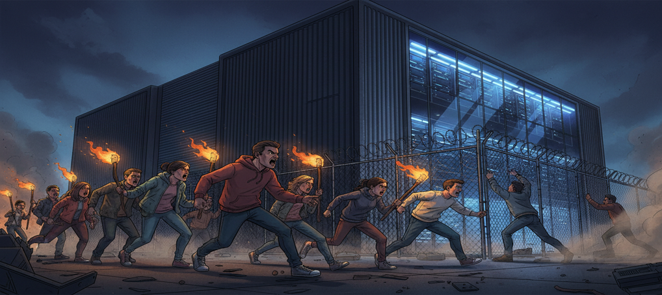
I actually think the voting could be constructive for the industry!
- Community outreach will play a bigger role in getting compute built.
- More knowledge and understanding would be a good thing.
- Pointing out the tax revenues these generate and what can be done with those tax revenues! This does not seem to get the attention it deserves.
- Being realistic on the energy (electricity) front and the water These are two issues that cause the most consternation (or maybe outright fear) surrounding data centers. These are real issues, but there are ways to mitigate them.
- Address secondary issues such as noise and pollution.
I think the industry will have to go to greater length (some length) winning over the areas they intend to build in. That is a good thing for everyone involved.
Here are some quick thoughts on the next steps on the compute build. Many of the views are predicated on the concept that more projects are not as dependent on “low latency,” meaning they have much higher flexibility around where they can be located.
- Some areas or regions will embrace the build. They want the tax revenue and have the required resources to build and run data centers. Run, don’t walk to those areas or regions.
- I keep thinking the industry will evolve “similarly” to how the Bitcoin mining industry evolved (it is not a coincidence that many of the crypto miners have evolved into more broadly defined “compute” centers). That industry moved to where the energy was cheap and available (and also to where the grid itself was not an issue).
- I think of “data centers” as becoming the new “oil rigs.” You run in shifts of a relatively small handful of workers at any given time. You fly them in and fly them out as needed.
- For security (both at a corporate level and at a national level) there will be some constraints on where data centers can be placed (Outer Mongolia might not be that secure, for example, for our data, even if it works for crypto, and possibly for Cheap Chinese Compute).
Stav Gaon at Academy has done a tremendous job digging into details on many of these threads, which I just toss around at a “macro” level. I highly encourage you to reach out to your coverage here to engage with Academy on the direction of the compute build, both domestically and globally.
Bottom Line
How markets and the economy respond to the election results ultimately comes down to how the winners and losers respond. A degree of friction is normal. Fighting, devolving into something more nasty, is not normal, nor good, but possible. So far the signals are more on the “friction” side of the equation, which is good.
As you can see, I’m optimistic that we can get a lot of good out of the results, which can not only help growth and spread the economic benefits to more industries, but also alleviate affordability issues.
Now I can get back to my regularly scheduled contrarian/cynical view of things. 😊