
Trying Not To Use It, But…Situational Unawareness
This is likely the hundredth (if not thousandth) report in your inbox with some play on Situational Awareness. As a rule, the T-Report tries not to be too derivative on our titles, but this one kind of writes itself. Besides, it’s the first weekend in August, so maybe we can cut ourselves a bit of slack, and go with the obvious title?
There is no shortage of things we can write about:
- Warsh, who isn’t as hawkish as some were led (or we would argue misled) to believe he was. His drive towards “less transparency” is increasing, as he floated the idea of having fewer meetings. Let the market talk! For too long the bond market has been too fixated on what a handful of people plan to do about short-term rates (and some exotic tools at their disposal). “We” (collectively) lose information when the market is trying to price the whims of a handful of people, rather than what it thinks is appropriate value. The signal-to-noise ratio gets completely messed up! It might take some time getting used to increased volatility in the bond market, but expect that shift to occur as the market starts having to think for itself, rather than trying to think about how the FOMC will think (they are not mutually exclusive, but they aren’t the same thing).
- Staggering market cap gains and losses. In a week where some mega caps traded like “meme” stocks, we could talk about earnings and market structure, but, you guessed it, we are going to focus on Situational Unawareness.
- Iran. Shortly after the markets closed, multiple headlines surfaced proclaiming an imminent larger-scale attack by the U.S. So far nothing has happened. Academy continues to monitor the situation, with a base case that what passes for the “ceasefire” will largely hold, and the U.S. will have to revert to economic punishment (including the highly successful blockade) to shift the narrative significantly. The big question mark for markets, as we see it, is how much more can we release from the SPR (Strategic Petroleum Reserve)?
Academy was fortunate to discuss “The AI Trade and Iran” on Friday’s CNBC’s Morning Call.
- Japanese Yen. Someone finally intervened in the market. After “chatter” about “price checks” (central banks checking levels with large banks), the Yen dropped from 163.85 on Tuesday, to 157.4 by the end of the week. It hasn’t been that strong since early May. Is further strength possible? Will that impact the “carry” trade? Normally the “carry trade” might warrant more thought, but for me, it is something that tends to get too much attention to begin with, and is only a minor player compared to the other drama playing out in real time.
Situational Unawareness
This is the focus of today’s report. Every conversation I’ve had this week tends to quickly move from earnings, AI spending, Iran, and the Fed to was the Situational Awareness sale a market bottom? The corollary, and equally important, is how much of the July weakness can be tied to Situational Awareness?
- The argument that this should be a temporary bottom makes some sense and we will examine why.
- The concern is that this is just the first “thing” (or second, if you want to include structured notes in Korea) in what may be a string of “things” (frequent discussions around the Bear Stearns hedge funds that were forced to liquidate, relatively early in the ABX calamity – the Big Short covers this).
The Financial Times broke the story and it was great to see that they picked up on Academy’s take on some of what is playing out in the AI Spend, and the markets.
If you are going to ask the market (or Wall Street) for help, you better do it properly!
We’ve seen multiple unwinds. We’ve been part of unwinds. It is the nature of the beast on Wall Street. When I think about how to “unwind” a messy, large, and somewhat illiquid position (which fits the bill for this fund based on everything that’s been published), there are a few things that need to be done:
- Work with truly deep, trusted relationships. The knee-jerk reaction can be to reach out to many people for advice and help. That tends to quickly work against you, as concerns about your positions spread rapidly. You can go to some of the “best” people in each area, but again, the more people in the “know,” the riskier it is. We don’t yet know what this fund did in the days or weeks prior to the sale to Citadel, but it would not be surprising if they didn’t play their cards as close to their chest as they should have.
- Misdirect and Obfuscate. The best way to get a good price on something is to convince everyone you are a buyer. Be Ruthless. Your existence is at stake. You can repair relationships over time (also, back to the prior bullet point, pick a very small number of partners or even one partner, and work closely with them, and do what you need to do with everyone else).
- I believe it was the summer of 2007 (though it might have been earlier). The market was sloppy. ABX (mortgages) were leading the way, which was putting pressure on banks, the mortgage sector, and financials more broadly. One prominent fund in the space was calling their salespeople asking where they could sell protection on a block of the CDX index. They didn’t ask for a market (where you would quote a two-way price, or even a live quote), just an indication where they could sell protection. With the market nervous, being in touch with a seller of protection seemed useful. Then, as the market was closing for the day (you always get more bang for the buck if you stuff the street near the end of the day, than at the beginning of the day), the salesperson asked for a market, on size. You made the market because that was your job. You maybe weren’t as afraid as you should have been about getting tricked, but the instant I heard “mine” instead of “yours,” I might as well have planted my face on the desk. Not only did they buy protection rather than sell protection (not great), but it instantly became apparent that they had at least 4 traders, probably with one phone in each hand, lifting 8 deals out of protection. Well organized. Patient. Relentless. Ruthless. I still respect them for what they managed to do, to this day. At some level, it is all a “game” and they played that game expertly that day!
The purpose of this section wasn’t to bring back bad (maybe even scarring) memories, but to highlight that “crisis” type situations need to be handled extremely well, or you can lose control of the narrative.
Very little of what has been published indicates that in the weeks leading to this sale, the fund had the expertise to navigate a crisis well.
This isn’t a “problem” that just emerged, it was something that they had to deal with since June, when indices like the Philadelphia Semiconductor Index (SOXX) stopped going parabolic and started experiencing some volatility. 10-day realized volatility for the SOXX went from averaging low 20s at the start of the year, to averaging almost 80 for the month of June. Normally, I’d look at longer-term realized volatility, but when you are talking about something allegedly 4 to 5 times leveraged, 10-day realized vol isn’t a horrible metric.
The performance of some recent IPOs (notably SPCX) and chatter that some IPOs might be delayed (OpenAI) likely added to the need to do “something” as this fund, by all accounts, held stakes in private companies.
Earnings or Situational Unawareness?
Let’s look at three companies that announced earnings, since the Situational Awareness sale broke.
- MSFT from $390 to $465! Over $500 billion in market cap in just 2 days!
- AMZN from $235 to $271 in just one day! About $400 billion in market cap on Friday!
- AAPL from $333 to $309 on Friday. A loss of about $400 billion market cap in one day!
I’ve never been a fan of the “efficient market” hypothesis. In fact, I strongly believe that “passive” investing has made the market even more inefficient (the passive investors are “freeloading” and transferring true price discovery to a subset of the market that doesn’t seem to be as big as the passive side of things). Add in leveraged ETFs and you have a whole mess of issues making markets less efficient.
But could the market really have been that wrong on just 3 stocks, with a combined market cap swing of $1.3 trillion, in less than 48 hours?
These are companies that are well followed! They are as liquid as any stock out there. Yet they behaved like “meme” stocks post earnings.
Let’s, for a moment, play out another scenario…
- You are a fund, almost exclusively focused on AI (presumably the picks and shovels as well).
- You have leverage.
- A chunk of your assets are very illiquid positions in private companies. While the official valuation may not change with market turbulence, your ability to get the same price you could have gotten in May versus what you could have gotten in June has almost certainly declined. We have seen again and again that private investments may insulate you from daily “mark to market volatility” but if you need to sell, the volatility is probably higher/worse on the private side of things than the public side of things.
You are now losing money, and you need to “fix” yourself (you know what word I wanted to use, a word that has never been published in a T-Report, but as more politicians seem comfortable using it, maybe it will wind up here one day). But I digress.
- You could call a few people and see if you can get out of some of your private investments (not a good idea in my opinion, see the prior section). You probably don’t get a “great” price on the wire, and realize you need other options.
- You start “hedging” with what you can, not what you have.
- “Fixing” your positions often starts with hedging what you can.
- If I had a portfolio heavily tied to AI, where I couldn’t sell, I might look for what I can short against it. A quick correlation analysis, taking size into account, might lead me to sell some MSFT or AMZN. Two companies, so liquid, that short positions should provide some gains if the AI Trade continues to suffer.
- Maybe you add an AAPL long position? AAPL was trading with a negative correlation to the AI trade. So maybe you buy some AAPL since it seems to go up when your other positions go down, mitigating the overall portfolio volatility.
Who knows if any of this happened?
I certainly don’t but there is a logic to it?
According to stories, the fund was sold at a 10% to 20% discount? Then “suddenly” stocks start moving 10% to 20% in a day, maybe just coincidence?
I suspect that much of the AI sell-off and recent bounce back was tied to Situational Awareness.
There was a LOT of HEAD-SCRATCHING around some earnings reports over the last few weeks. We included some in last weekend’s AI Spend Slowdown.
How much of that “head-scratching” goes away if you consider a fund trying to stave off some serious leveraged risk?
That fund trying to keep its head above water, feeding its trades into an ecosystem ripe with issues (leveraged ETFs, 0DTE options, etc.).
Market Bottom or Archegos?
I’m guessing all “blow ups” wind up with a sense of irony in their name in hindsight. Long Term Capital? All of the Star Wars vehicles created by Enron? Archegos as a “prince” or even reference to Jesus (that’s what Grok told me). Add Situational Awareness to that list.
But I drag up Archegos because my recollection/belief is that some of the names he invested in never got back to their highs when they were leveraging them and pushing shorts. A couple of the tickers no longer exist (mergers, etc.), so we didn’t spend much time on them. Let’s just look at Baidu.
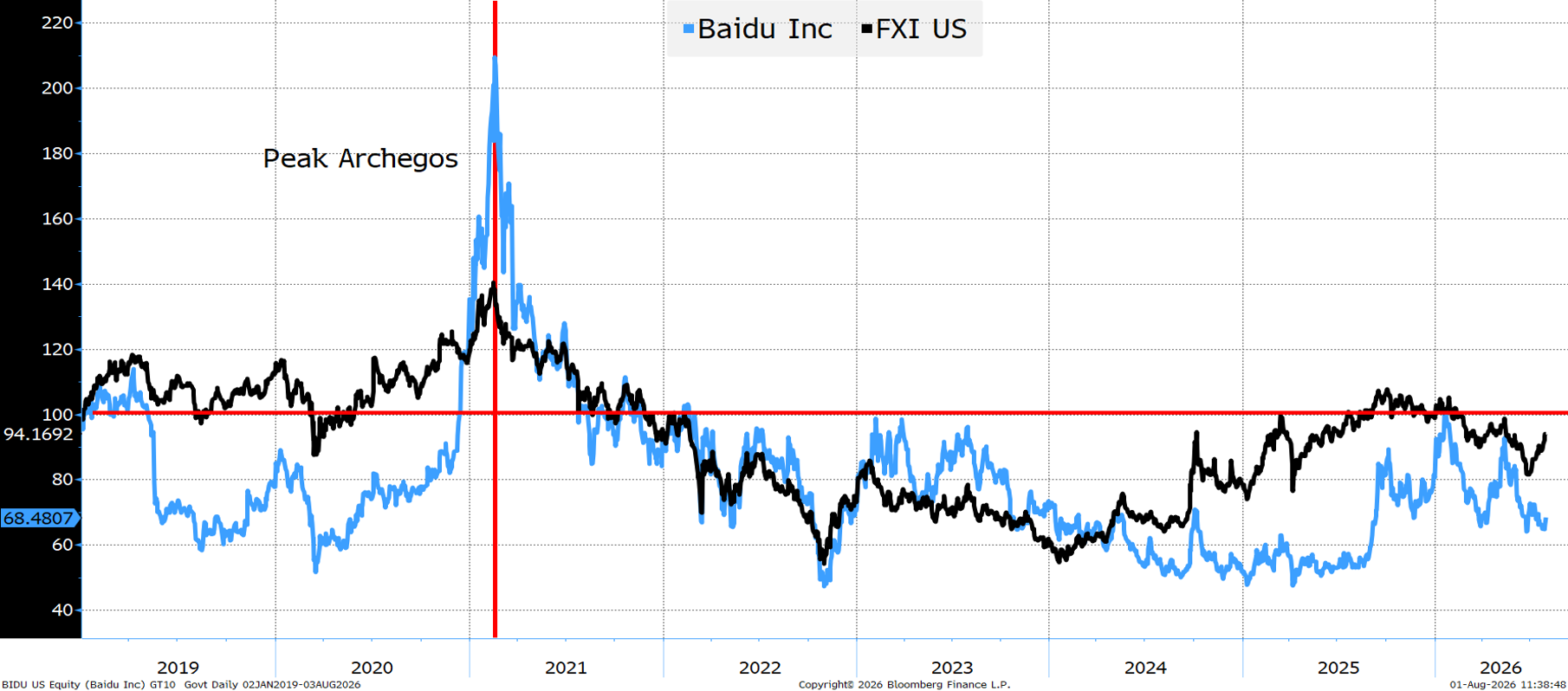
There is a lot that has changed between 2021 and today that has impacted the prospects of this company (and Chinese companies in general). That is why we included FXI (a large cap China ETF) in the analysis.
Did Archegos really drive the price of a big, well-followed company, to levels that haven’t been even close to being replicated 5 years later? (Is it just coincidence that several of their largest holdings back in their heyday have similar patterns)?
Should we be spending less time wondering if the bottom is in, and more time wondering if the top is in?
I don’t know, but it probably needs to be thought about.
Bottom Line
I suspect that performance for the coming days (and maybe weeks, or longer) will come down to understanding what role Situational Awareness has played in this market. Not just the last few weeks of volatility, but also to the start of the year (or earlier) when we saw some parabolic moves higher develop.
It might be easier to say it is all about earnings, and move on, but I think we found a real puzzle piece that we need to fit into the narrative of price, valuations, and future spend. I’m sure some were probably more focused on this earlier and that is a failing on the part of the T-Report. On the other hand, it is a puzzle piece that fits into our market structure concern quite easily.
On rates, Warsh wants a cut, but the data is not working in his favor, and the longer the conflict in Iran goes on, the more difficult it is to see the inflation story giving him the cover he needs. I’m still incredibly skeptical that we will see a rate hike, especially if the inflation story can be easily linked to the war (which so far seems to be the case).
- With the world, including some countries in the Middle East, needing to borrow to fund defense spending, the supply/demand equation for bond yields globally is in favor of the buyers, making it increasingly difficult to see yields move lower (4.5% on 10s seems far less likely than 5%).
On credit, it is difficult to believe that this week started with a lot of conversations on our call to buy bonds linked to the AI Space. For now, we may have been right, for the wrong reasons! The bonds we like saw spreads widening early in the week, and they only came roaring back on Thursday and Friday as the AI Trade was back on (though, as you know, I suspect that had a lot more to do with moves spurred by Situational Awareness than anything really organic). Taking credit risk in the AI space still makes the most sense to me, as the real drivers are:
- Costs and time overruns mounting.
- Increasing difficulty, in many areas, on the regulatory approval side.
- Cheap Chinese Compute.
- Increasingly, people are able to “question” whether they are getting a good ROI on their token spending, which probably isn’t good for future token spending.
No one has “flinched” on the AI spend, but last quarter’s earnings and estimates for the future based on the last quarter (and even more recent info) don’t force me to believe these risks are already priced in! Hopefully, August is less troublesome than July, but I suspect it won’t be. ☹