
No Hikes For You
Much of the country is facing extreme heat and humidity this weekend. It makes it difficult to read and get ready for the week, let alone write something for this week, 😊so we will keep this one short and focus on charts.
The markets started and ended the week with a bang. We continue to keep a close eye on the stocks and sectors most affected by Situational UnAwareness (last weekend’s T-Report). The Nasdaq 100 had an insanely strong Tuesday, gave up some gains Wednesday and Thursday, only to claw back those gains on Friday, primarily after the weak employment report hit the tape (Houston We Have a Data Problem). At what point will we spend the money to totally revamp how we collect and process data? “Surveys” seem incredibly “old school” when so much real-time information is available. We will see if the worst is behind us on the AI spend story.
- We continue to like buying the bonds being issued to fund data centers and AI. We’ve been writing about this with increasing frequency. It was almost amazing to see Alphabet do such a massive bond deal on a Thursday in August. The size of the order book is indicative of how prepared the market is to absorb the expected supply, which is why I think the surprise will be for a rapid move tighter than ongoing weakness (all we need is one company to discuss potentially slowing their spend given all the hurdles we have been writing about for the past few weeks).
We touched on a lot of these issues on Bloomberg TV on Thursday, in case you prefer to watch/listen, rather than read (our segment starts at the 1 hour 43 minute mark).
No Hikes For You
According to the Bloomberg WIRP function, the market went from pricing in a full hike in September, as recently as July 24th, and is now back below a 50% chance (which I think is still too high).
- JOLTS was mixed. The employment component of ISM Services was below 50. ADP was better than NFP but left a lot to be desired (44k jobs). It is reasonable for the Fed to question the strength of the job market.
- Let’s examine Truflation a bit more closely.
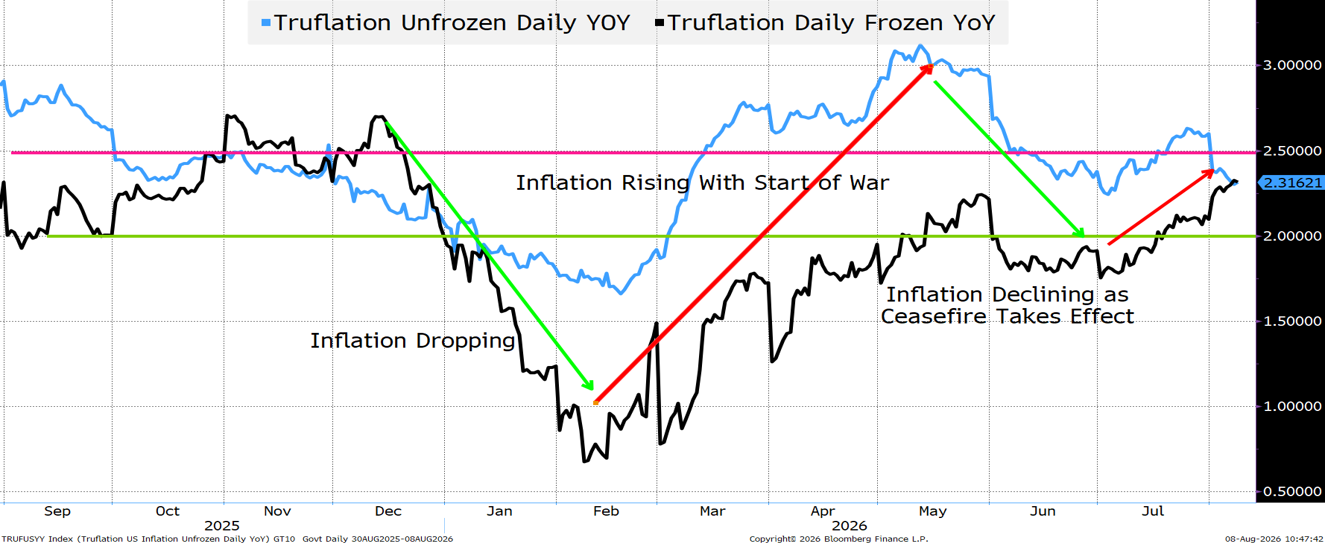
We include “frozen” which is the time series as originally published with no attempt to revise it as more information is available. The “unfrozen” version is effectively a “revised” time series.
The pink line is 2.49%, because 2.49% rounds down to 2% if we are using only whole numbers (that may seem like “cheating” but I think Warsh, in particular, thinks more “in the vicinity” of 2% rather than 2.0%).
The beauty of this data is that it makes sense to me. Just a quick glance at this data seems to “jive” with what we’ve been experiencing (and notice it is all below 2.49%).
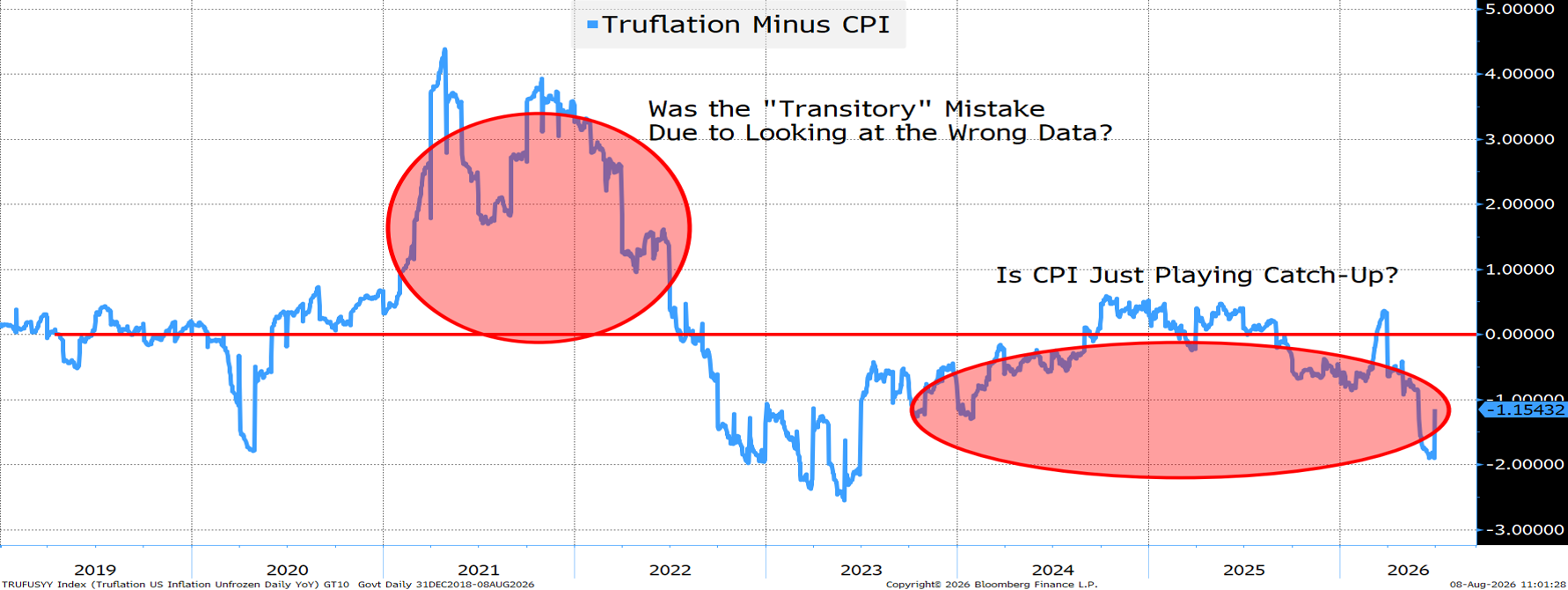
In this chart we explore the difference between Truflation and CPI. Truflation was much higher for 2021 and 2022 than CPI. Honestly, that seems correct! While the barbaric way in which shelter is calculated for CPI played a big part, it is not entirely to blame. Now CPI is higher than Truflation. Why? Because maybe it is just catching up? Imagine if the Fed was focused on Truflation rather than CPI in 2021 and 2022. Would they have hiked sooner? Would they have continued with QE as long as they did? We will never know, but treating CPI as a “gold” standard and dismissing metrics like Truflation seems nonsensical to me.
This is also why I’d argue that we have an “affordability” issue more than an “inflation” issue. The problem isn’t so much in today’s price moves, it is that the price moves we were hit with back in 2021 and 2022 were not properly reflected in the data! (Yes, this is a hill I’m prepared to defend). Not saying Truflation is perfect by any stretch of the imagination, but it is pretty easy to see a policy path that is very different than the one we’ve taken if they looked at more types of data.
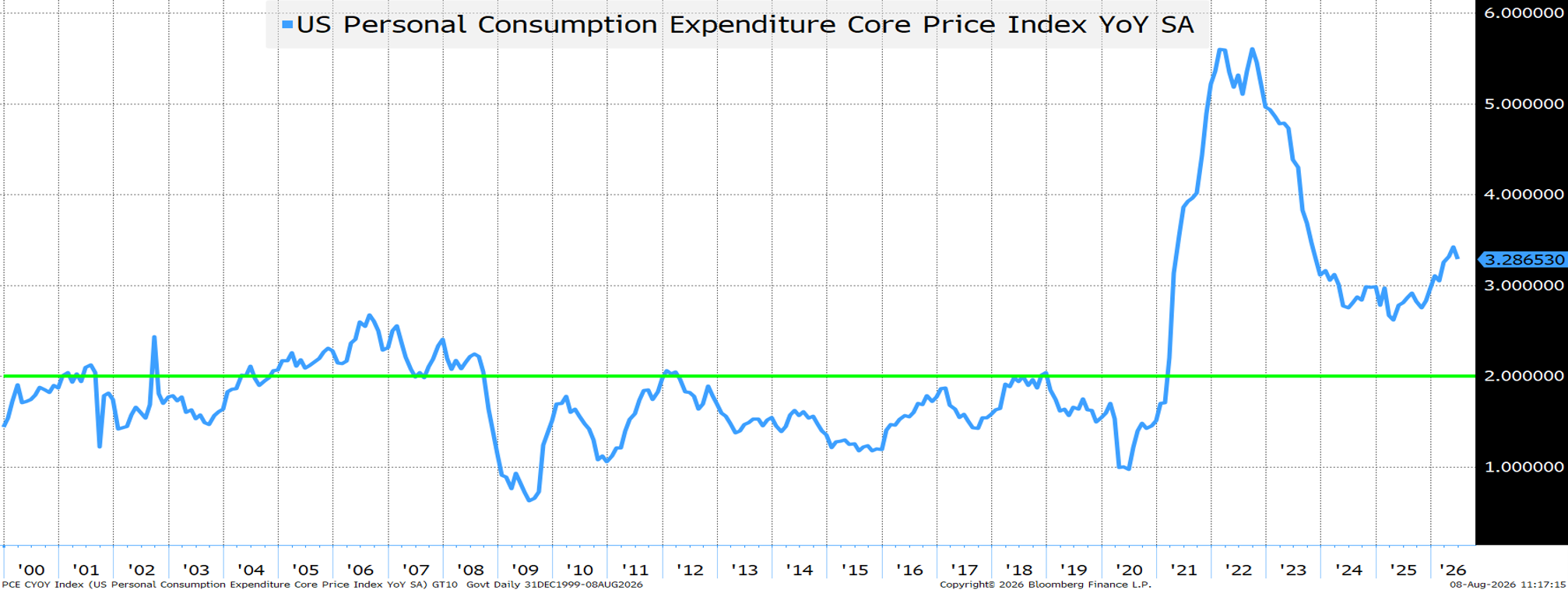
I’ve always thought the Fed liked core PCE as their favorite metric, because it was almost always below 2%! It was “convenient” that their “preferred” metric was never above 2%. Literally, from 2008 to 2020 it was almost never above 2%. Maybe I’m being a bit too cynical, but I think the Fed liked to point to this measure because it gave them the flexibility to be more dovish, rather than because it was so much more useful, relevant, and accurate than other bits of inflation data we get.
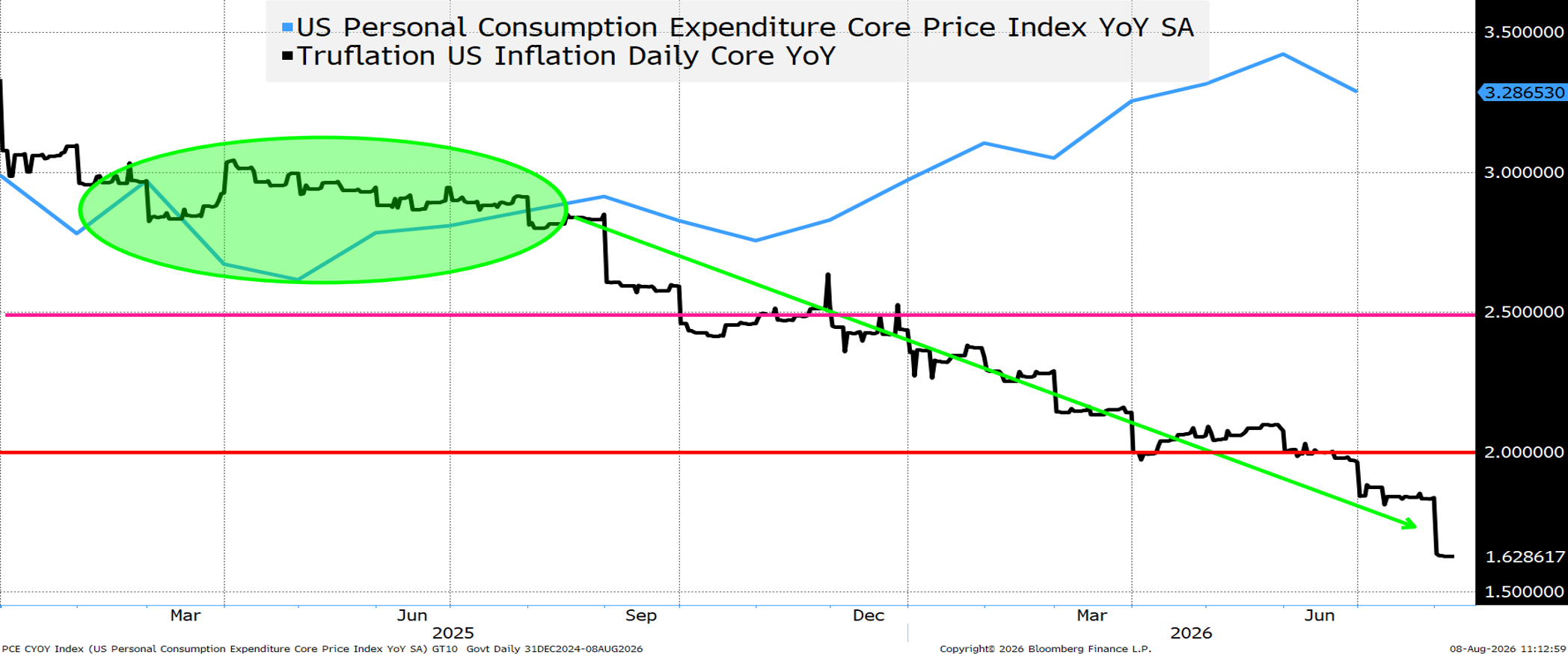
If you can agree that other data might tell a good story and that this pedestal that Core PCE has been set upon doesn’t make sense, then maybe we should be cutting? It isn’t like Truflation Core is “always” below PCE (which is why we put in the nice green oval), but it is certainly much lower now! And the rate of decline (inflation) actually makes more sense to me than the PCE numbers. The large price shocks are behind us in the real world, but unfortunately they are still appearing in the data world the “old Fed” looked at. I am pretty sure I still have a 12C lying around (anyone on Wall Street from the last century knows how ubiquitous they were on trading desks), but I cannot remember the last time I thought about using it!
- Warsh was basically put in charge to cut. He will deal with the hand he has been dealt (the renewed conflict in Iran isn’t helping), but his bias is to cut, not hike.
- While it is unclear where we stand in Iran at the moment, it seems like we are on the verge of getting some sort of agreement between Oman and Iran to re-open the Strait in some capacity. It seems as though they are negotiating something that will be agreed to by the U.S.? It all seems a bit weird, and goes against the military successes, but it seems to be headed in that direction. If the Strait is opened AND the U.S. encourages Iranian oil sales (like we did at the start of the MOU) then Warsh’s job of steering the Fed to a cut gets a lot easier (and the hawks may have to change their tune rapidly).
Bottom Line
The long end of the yield curve is likely to remain under some pressure as the global supply of sovereign and corporate debt continues to soar.
The front end will start pricing out fewer hikes. Probably far too early to price in cuts, but the hiking story is crowded, and I think wrong. It will require more people to break years of tradition and base decisions on the same set of data, regardless of being aware of the inherent flaws in the data!
Credit spreads should do well, though I like the AI/Data Center plays even more on an all-in yield basis than just spread. It is cheap and positioning has corrected itself to where the move to tighter spreads/lower yields seems to be the more likely path.
With chatter of investors looking to put money into the hands of the fund manager that ran Situational Awareness, those sectors could do well. I’m neutral there, as I think there is another round of AI “doubt” creeping into the narrative which will hurt valuations (while supporting the credit side of the story).
On the rest of the equity markets, I’m biased towards ProSec™ globally. Across the globe, energy, electricity production, smelting, processing, and refining will do well. I’m both surprised and happy that Australia committed to its first new refinery in 60 years! Each country (or region) will need to prioritize their efforts, but we see this happening.
- Look for the government wallet to be used to direct these developments and projects. Not just by direct involvement in projects (which will happen) but also by putting conditions on what the government will buy, to the extent that it makes projects economical, where they otherwise wouldn’t be. Low cost is taking a back seat to National Security – globally!
- The ProSec™ Hierarchy will vary across the globe. Some regions will need to focus on food and water. Others (Europe) will need to focus on military production. (I’d create an Airbus for Drones if I were Europe). Chips, AI, and compute will need to be prioritized. (I’m increasingly concerned that there is a danger of Cheap China Compute hitting us far sooner and harder than we’d previously thought!).
- The President “kicked the hornet’s nest” on global supply chains. The intention was clearly to grow U.S. exports. That can happen, but increasingly, there is a “domestic” intent globally, providing a real opportunity in other markets that embrace that mantra!
With weather forecasts sounding right up Adrian Cronauer’s alley, it seems like a good time to conclude with the most useful advice I can give – Stay Cool My Friends!