
I Am The House Now
The Secretary of the Treasury gave markets a lot to think about yesterday, when he announced that he “is the house now”. The statement was focused on the Yen and the “intervention” / “direction of travel” there.
Having said that, the buyback schedule from the Treasury is going to be announced this morning. Should be 7 longer dated bond buyback operations in the next 8 weeks. He steered markets towards $4 billion, up from $2 billion, but most expect a bigger number (need it to get some “shock and awe” effect).
But let’s think about what it means to “be the house.”
On the “fun” side of things, lots of Captain Phillips memes out there already.
On the more discouraging side of things, at least from my perspective, this is yet another step down the inexorable path to full yield curve control (we’ve been heading in that direction for decades, little steps at each “emergency”, and it seems inevitable that we will eventually wind up there) but that isn’t today’s concern.
As a contrarian one of the first thoughts that popped into my head is that the only “force” more punishing than the golf gods (and the golf gods always find a way to punish you) is the market gods. It seems dangerous to be direct and convinced of your mastery of markets.
Bernanke, in 2005 (before being Fed Chair), suggested that a nationwide housing bubble was unlikely. In 2007 he proclaimed that the subprime mortgage mess was “largely contained”. We all know how those viewpoints turned out.
I’m also old enough to remember that we were going to be “jiu-jitsuing Iran with its own oil”. I never understood how that would work, and not sure it ever did much (the naval blockade that was put in place has done a far more effective job of clamping down on Iran’s economy).
But let’s get back to the task at hand, the Japanese Yen (though the real task is U.S. yields, but let’s start with the “easier” task of intervening with the USD/Yen exchange rate).
- The yen has seen several “interventions” or at least very sharp moves since the start of the year.
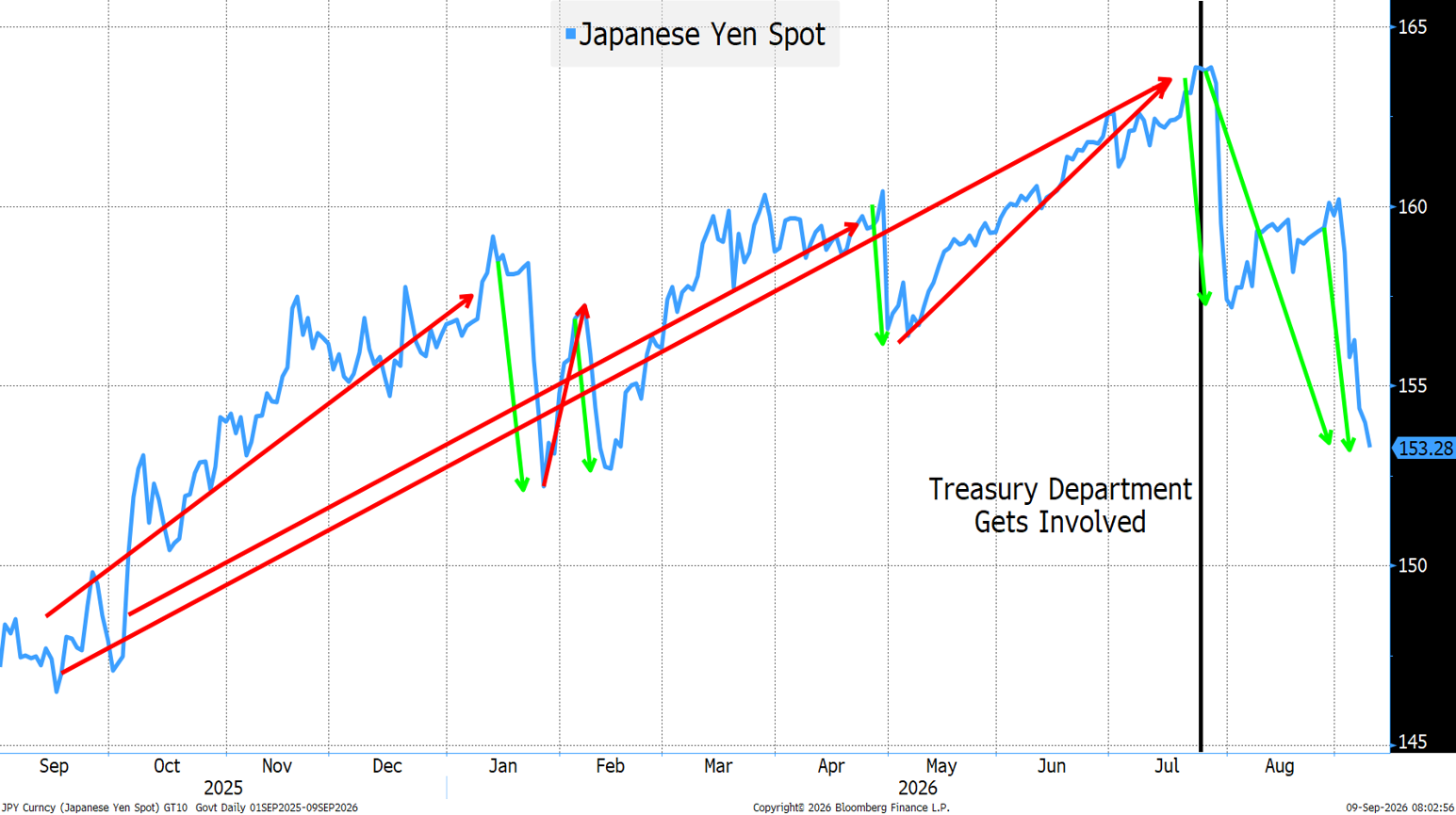
None of those interventions lasted long and not only reversed but also saw an even weaker yen. But then Bessent got involved, providing the means for Japan to strengthen/intervene without needing to sell Treasuries or raise dollars through other means. Since then, although the market started to fade the intervention, it has resumed on its course of strength.
- The intervention, which has been coordinated between the U.S. and Japan, has worked. We are down to 153 from 163 and successfully fought the attempted fade.
- Without a doubt Bessent has asymmetric information. Not just on what Japan is likely to do (that was the area he focused on), but also presumably on other cards the U.S. can play.
So far, the intervention is working and we can assume that Bessent knows more about Japan’s policy debate than even the most plugged in market participants.
But this is potentially where it gets “interesting” or at least playing devil’s advocate:
- If Japan was planning on implementing monetary policy to strengthen the yen (presumably rate hikes), are they still inclined to commit to the same path now that the yen is almost at its strongest level of the year? Markets and responses are constantly evolving. We often say that the “cure” for high commodity prices is high commodity prices, because markets react to various incentives. Is Japan as incentivized to hike today as they were a few weeks ago?
- According to Bloomberg’s WIRP function there is a 61% chance of a U.S. hike at next week’s meeting. If rate differentials matter (they do have an impact in the FX market, though I do think it is overstated) then is Japan planning on hiking enough to offset our hikes? Kalshi is at 54% (and I’m still at 0%, for all the reasons listed in recent T-Reports).
- Which brings us to the “oddity” that the Treasury Secretary knows with greater certainty: what Japanese monetary policy will be versus our own monetary policy. I have no doubt that Bessent knows what Warsh is going to try to accomplish at the next meeting. It would shock me if he hasn’t been trying to influence other voting members to do what the Treasury Department wants them to do. But does he know with any degree of certainty?
- Is Japan comfortable that their monetary policy seems to be dictated by the U.S.? There is a natural aversion to being “told what to do”. Maybe Japan planned on doing a lot and was very happy to comply, but do they want to be seen as a toady?
I would not bet against the yen continuing its appreciation, but something about the past 24 hours seems “off” and is fraught with some risk.
Back to Treasuries
While the level of the yen is important, particularly for corporations, the ability to control the long end of the yield curve is more important to more people.
Can the Treasury Secretary “be the house” for longer term Treasury yields?
- A rate hike next week would do a lot to help longer dated bond yields. It would solidify the Fed as independent and being willing to fight inflation (even if a rate hike to ward off inflation from a war and compute build that won’t slow because of a rate hike, is misguided policy). A hike would also quickly increase the U.S. interest expense as so much of the burden has been shifted to T-bills. It would also increase the cost of carry on the Fed balance sheet (almost $7 trillion), which would also add to the deficit (we the taxpayers benefit from gains the Fed has and pay for losses). Is he really pushing the Fed to hike? I find that hard to believe. Given the President’s comments on rates, post NFP, it would take a brave man to convince the President that “this hurts me more than it hurts you” on the need to hike, not cut.
- Getting the Fed to initiate Operation Twist would be powerful. The Fed’s Treasury Holdings could be an extremely powerful tool! That doesn’t appear to be in the offing, so don’t think we get this any time soon.
- The Global Supply of Debt is a real issue. The $40 billion of USD investment grade new issue on Tuesday was considered “light” for the Tuesday after Labor Day (though a record setting August helped reduce the rush).
The U.S., between the Treasury and the Fed, can probably set the yield curve anywhere they want (yield curve control), but it would take a lot more coordination and urgency than we’ve seen so far.
Bottom Line
In Vegas, the house always wins (otherwise casinos wouldn’t be such good businesses). But the casinos take a “sliver” of the action, not big outright risks. I’m not sure the “house always wins” is the right meme for the Treasury Secretary to be going after.
Arguing that he has the deepest pockets, is completely insensitive to losses, and has no limits, is the better meme.
That meme would scare the heck out of me. That is a “whatever it takes” theme, which is what it took for Draghi to turn the European debt crisis around.
We are closer to a “whatever it takes moment” on yen intervention (coordination, and a much smaller market relative to the global market for debt in all currencies) than we are in the attempts to peg the longer end of the yield curve. The yen is what Bessent’s quote refers to anyways, and the potential meaning for Treasuries and yields is merely extrapolation.
In the meantime, “being the house”, “asymmetric information”, and a small amount of buying relative to the deluge of debt, doesn’t seem enough to control the long end of the yield curve here.
An end to the war in Iran would help global bond yields as it would let oil flow freely and the global refining system to operate most efficiently. Increasingly, an end to the war between Russia and Ukraine would help as well. In the past few weeks, more and more people in the energy space are expressing concerns about the supply from that region, as Ukraine steps up their attacks on Russian energy infrastructure.
For now, I wouldn’t fight the yen (but am curious to see how Japan responds in the coming days), but am quite comfortable fighting the longer end of the yield curve, purely based on the fact that the sizes being bandied about just don’t cut it in terms of global debt issuance.