
Around the World with Academy Securities
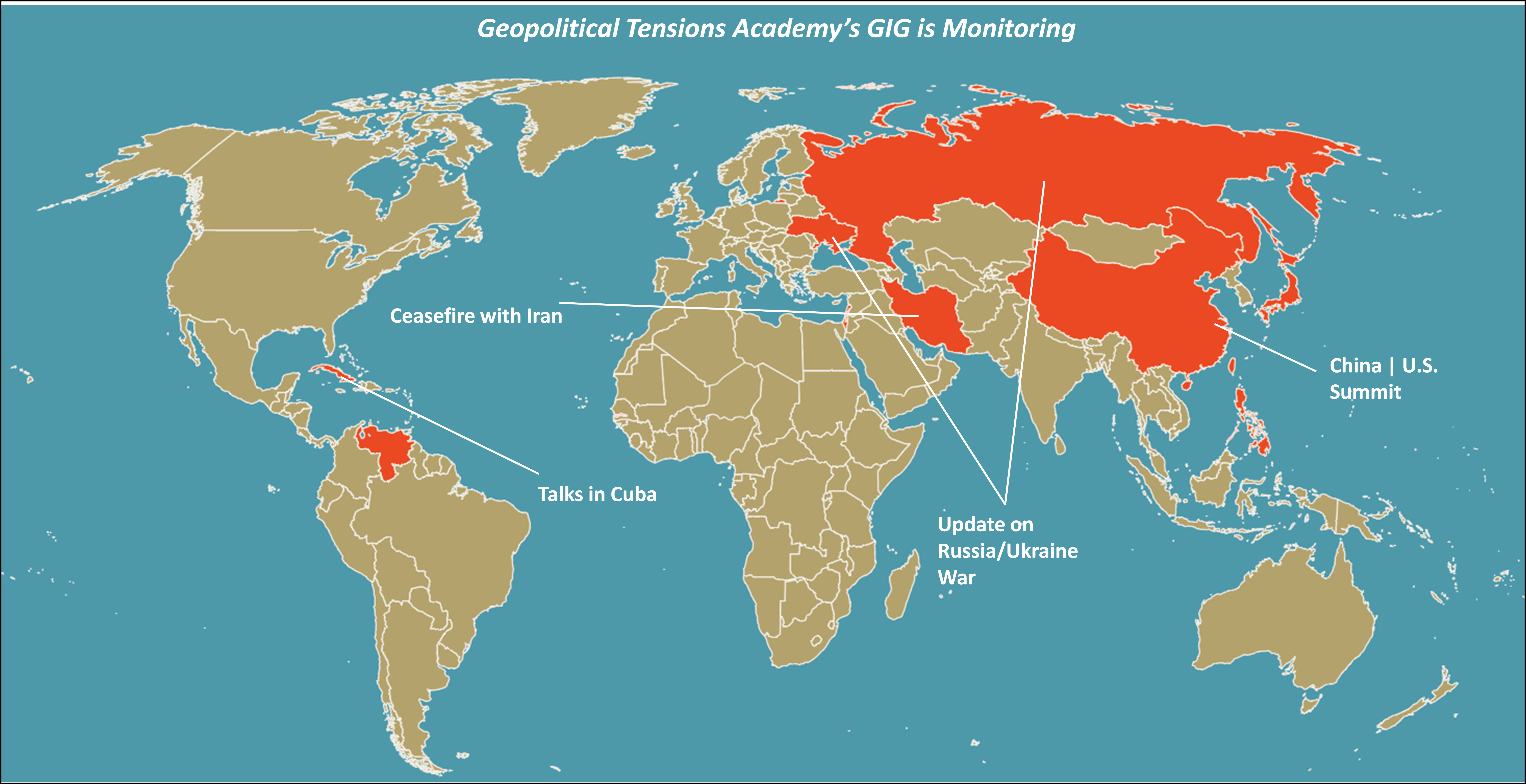
In this month’s edition of Around the World with Academy Securities, our Geopolitical Intelligence Group (GIG) focuses on the following geopolitical tensions that we are monitoring:
- Ceasefire with Iran
- Talks in Cuba
- Update on Russia/Ukraine War
- China | U.S. Summit
We begin this report with an update on the ceasefire with Iran as talks scheduled for last weekend with the U.S. in Pakistan did not come to fruition. While the ceasefire in Lebanon is holding (for now), which was a major pre-condition to moving the Iran peace talks forward, Iran has cited the U.S. blockade as a reason for the delay of the second round of negotiations. However, the primary reason why President Trump decided to extend the ceasefire with Iran indefinitely was due to the fractured nature of the Iranian leadership. The nuclear program has become the largest single point in the negotiations, and the U.S. will continue to apply economic pressure via the blockade of Iranian ports to force the regime back to the table to come to a satisfactory deal. Next, we revisit Cuba and the recent talks with the U.S., which were the first in a decade. The U.S. blockade of oil imports to the island is having an economic impact and the goal here is a major change in the regime that will eventually allow for sanctions relief and investment in the country. We also provide an update on the war in Ukraine as the $106 billion loan from the EU was finally approved after Hungary dropped its opposition to the plan. This will provide Ukraine with a much-needed influx of cash to continue to support the acquisition of weapons to push back the Russian spring offensive. We also report on the scheduled U.S.| China Summit in mid-May and the possible agenda items. Finally, we will be watching North Korea, as it is important to note Admiral Roegge from our GIG believes that historically when the U.S. focuses on other challenges, this is when North Korea looks for an opportunity to get attention.
Please reach out to your Academy coverage officer with any questions and we would be happy to engage.
Front and Center: Ceasefire with Iran
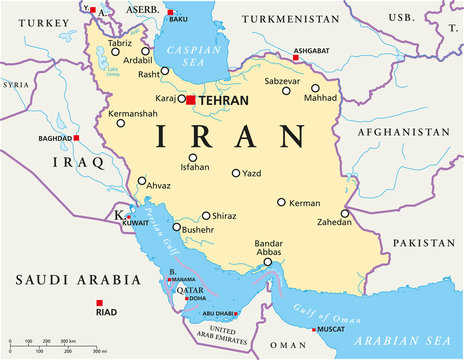 As we reported in our SITREPs and podcasts, the ceasefire with Iran has been extended as talks were expected to continue. In addition, the fragile ceasefire in Lebanon was extended for another three weeks. However, on Saturday, President Trump canceled plans for two of his top advisers to go to Pakistan. Earlier that day, Abbas Araghchi, the Iranian foreign minister, left Pakistan after holding discussions with the country’s leaders. With the U.S. blockade of Iranian ports in the Gulf still in place, the strategy appears to be to continue the pressure campaign designed to damage the Iranian economy and drive the leaders back to the table for face-to-face discussions with the U.S. While restricting Iran’s oil exports will take some time to impact its economy, the effects are already being felt as Iran is running out of space to hold the oil it is producing and the risk is that they will have to slow or even stop production which will have a longer-term impact on their oil wells. The likelihood of the U.S. deciding to resume military attacks against energy and transportation infrastructure will increase the longer Iran waffles and does not return to negotiations. A big factor in the delay is due to the fractured nature of Iran’s leadership with more moderate leaders like Ghalibaf not agreeing with individuals like General Vahidi, the new head of the IRGC, who is seen as more hardline. There also appears to be little to no direction coming from the new Supreme Leader, Mojtaba Khamenei, who was badly injured in the February 28th strikes that killed his father and many other key leaders. With the USS George H.W. Bush CSG and USS Boxer ARG/11TH MEU arriving in the CENTCOM AOR, the U.S. is prepared to increase the blockade and pace of interdictions of black fleet vessels coming into and out of Iran as well as to potentially restart military strikes.
“The U.S. ceasefire extension is prolonging both sides’ focus on economic pressure to secure concessions ahead of another round of talks. The ceasefire negotiations are in a coercive bargaining stalemate that is fragile and unstable and could lead to another round of military escalation by either side. The U.S. is focused on containing Iran’s nuclear ambitions, maintaining maritime freedom through the Strait of Hormuz, and stopping Iran’s support of regional proxies. Iran prioritizes regime security and views calibrated escalation as a source of leverage. Neither side has the decisive pressure to enable compromise or capitulation. Iran retains geographic and economic leverage, while the U.S. can sustain prolonged economic and military pressure. The most likely outcome is a cycle of episodic escalation followed by short-term de-escalation, repeating without meaningful resolution in the near term.” – General Robert Walsh
“It’s difficult to distill whether or not the inaction by Iranian leaders is a function of internal discord, or just a lack of pragmatism and a persistent reticence that tends to define their actions when they are pressed economically and militarily. I believe the current administration is satisfied to continue mine-clearing operations and trying to convince the world that the SOH is navigable and safe. No doubt USCENTCOM intelligence officers and targeteers are busy building the next list of strike options. I don’t think the President will pull the trigger on any of those unless U.S. interest/forces are directly threatened in a kinetic exchange.” – General John Evans
“Given the discord among Iranian leaders about how to proceed with the U.S., I think a deal before the upcoming summit with China is unlikely. I think we will have to sustain the blockade, continue to clear the SOH of mines, and work with other countries to eventually provide escorts for ships through the SOH. I think Trump will remain committed to a ceasefire since the conditions allow the U.S. military to focus on these missions. It is going to take immense economic pressure and a change in the perception that Iran has the upper hand in the SOH for Iranian leadership to capitulate.” – Admiral Kelly Aeschbach
“The U.S. will need to exercise strategic patience and resolve in achieving a negotiated settlement with the Iranian regime beneficial to U.S. interests. This means that we will need to continue our sanctions enforcement operations via our naval blockade against ships leaving Iranian ports while pushing hard—to include possible military escort operations—to get legitimate commercial transit flowing through the Strait of Hormuz. There will be no rush to re-commence military strikes against Iran short of those needed to free up the Strait of Hormuz or to counter any Iranian efforts to retrieve the highly enriched uranium currently entombed primarily in Isfahan. Beyond that, doubling down on sanctions enforcement and exerting maximum economic pressure on the regime will, over time, be the best path forward for the regime’s returning to the negotiating table and acceding to key U.S. redlines. Additionally, expect factions in Congress to clamor later this week for Congressional action related to the administration exceeding the sixty-day mark of military action against Iran without Congressional approval. At the end though, Congress will likely not take any meaningful action to curtail this operation and will almost certainly not cut funding to our forces in the region. The end of the sixty-day clock will likely get a lot of media attention this week but will be of little consequence.” – Joe Zacks, Former CIA Deputy Assistant Director for Counterterrorism
“I continue to maintain that we should not expect the Iranians to negotiate against themselves any time soon. Uncertainty in the Strait about when, and if, commercial vessel captains (regardless of flag) will feel as though the risk calculus is in their favor continues to be a card the Iranians hold. And, while the U.S. Navy has employed an impressive and effective blockade of Iranian ports, the recent seizure of commercial vessels by IRGC forces indicate that we don’t have the deployed force structure to conduct both blockade and escort operations. I believe we are likely to see continued IRGC hit-and-run ops that will frustrate the administration and stress the ceasefire. Couple these operational ‘realities’ with the fact that the U.S. and Iran continue to be influenced by asynchronous strategic timelines leads me to believe the Iranians are not yet ready to be serious about any substantive negotiations.” – Admiral David Buss
“With the news that POTUS pulled the U.S. negotiating team but also announced an extension of the ceasefire in Lebanon, we seem to be in a stasis – the blockade continues, Hormuz stays closed due to IRGC threats, ceasefires of a sort continue, but no negotiations. Leadership in Iran is unclear since the rise of BG Ahmad Vahidi as leader of the IRGC. Given that three of his predecessors have died commanding the IRGC, Vahidi is in a delicate situation if the ceasefire suddenly ends. In the revolutionary regime of Iran, the IRGC commander reports to the Supreme Leader, who may still be in a coma. He does not report to President Pezeshkian or the Speaker of the Majlis (Parliament) Ghalibaf. As Iran was not self-sufficient in gasoline, diesel, or food before the war, the question is how much longer can Iran hold out without the now-blockaded seaborne imports? Iranian crude exports are also blockaded, and their storage tanks are filling. At some point, they have to ‘shut in’ producing fields with longer-term implications for capital requirements to re-start oil fields and for possible irrecoverable damage to reservoirs. Meanwhile, since 80% of Hormuz shipments went to Asia, continued Hormuz closure will lead to shortages of LNG, refined fuels (especially jet fuel), and helium which will start significantly impacting Asian economies. As a not-so-subtle subtext, POTUS and SecWar Hegseth have made it clear that those depending on Hormuz need to do more to open Hormuz as the U.S. Navy maintains focus on the blockade. Speculatively, this stasis could continue for some weeks ahead and may set the stage for an interesting POTUS-Xi summit, which the war has already delayed.” – General Rick Waddell
“Regarding timelines, even if we reach agreement on the basic framework of a negotiated settlement – a high bar in itself – finalizing technical details will take time. Verification, inspection protocols, enforcement mechanisms, and the identification of a mutually acceptable third party or international body to monitor compliance are extraordinarily complex issues. I find it highly unlikely that we’ll have a comprehensive, enforceable agreement before the Xi–Trump meeting in May.” – General Karen Gibson
“The blockade will increase the economic pressure on the regime but will unlikely be sufficient to force the Iranians into comprehensive negotiations. Moreover, the negotiations remain problematic as the IRGC, under Vahidi, appears to be able to veto any terms agreed to by the political leadership who are more inclined to seek an agreement. What we are seeing in the regime is not a fracture but rather disagreements on strategy and timing. Vahidi appears to think the economic pressure will cause the U.S. to blink first. I would be looking for some posturing by both sides to decouple the highly enriched uranium and broader issues from the ceasefire and Strait opening given the 18 months it took to reach the original JCPOA framework. Meanwhile, the most complicating factor is the mining of the Strait and the resumption of commercial traffic to scale. As we’ve seen in the past, Iran lacks the discipline to record the disposition of all their mines and that is likely the case today which means it will take several months to completely clear the Strait. This delay allows the administration to press on with the blockade and sustain economic pressure on Iran in the near-term, while the Navy and additional resources are brought to clear the Strait and scale up escort duties. Neither side is looking to return to a kinetic exchange, however we should be clear-eyed as the Iranians retain sufficient missiles, launchers, drones, mines, and small maritime craft to hold the Strait at risk and continue strikes against Gulf nations.” – General Robert Ashley
Talks in Cuba
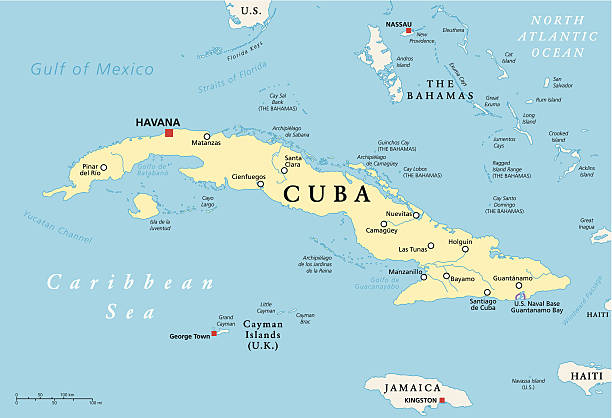
As we addressed in our previous ATW, the economic pressure campaign against Cuba is slowly grinding the economy to a halt. The oil blockade on Cuba has accelerated the energy crisis, and nearly every aspect of Cuban society has been impacted. However, last week it was revealed that Cuba and the United States are continuing their discussions and recently held high level diplomatic talks in Havana. Reportedly, American officials met on April 10 in Havana with Cuban officials, including Raúl Guillermo Rodríguez Castro, the grandson of former leader Raúl Castro. Although Castro does not hold an official government position, he has been in contact with Secretary of State Marco Rubio and his team at the State Department. While Cuban officials have likely been trying to negotiate a way to end the oil blockade on the country, that will only come with significant changes to the regime. Rubio has called for “drastic” economic and political change on the island, and the expectation is that as the pressure mounts, the regime will be forced to make concessions to stave off an even worse economic and humanitarian crisis that could lead to a complete collapse of the economy. The goal would be new leadership that is in support of eliminating Russian and Chinese influence on the island and is more closely aligned with the U.S, in exchange for sanctions relief and investment to help rebuild the economy.
“The recent visit by senior U.S. officials to Cuba marks the beginning of early-stage, exploratory talks rather than a shift towards normalization. Just like with Iran, Cuba has historically shown that extreme economic pressure can persist for years resulting in economic adaption without capitulation to U.S. demands. The increasing pressure on Cuba by the U.S. after the successful change in Venezuela’s regime has caused severe humanitarian strain with limited discussion of political change. Positive signs have been the U.S. allowing select Russian oil through its energy blockade while Cuba has met a U.S. demand to release some political prisoners. The most likely path is prolonged U.S. economic pressure with slow incremental concessions and little chance for a near-term breakthrough. Russia and China will provide limited economic and diplomatic support as they did in Venezuela, but it is unlikely to offset U.S. leverage.” – General Robert Walsh
“If the U.S. removed all pressure today, the Cuban regime could only continue to exist as a global charity case. Under the regime, Cuba does not produce enough of value (sugar, tobacco, revolutionary tourism) to trade for adequate supplies of food, fuel, and medicine. The regime’s feeble attempt to attract investment from the diaspora that the regime itself exiled is laughable. Negotiations with the Trump administration are likely the only salvation. What is not yet clear is whether those negotiations seek regime change, or as in Venezuela, regime stability with merely a leadership change, plus a commitment to some sort of political and economic reform agenda under U.S. tutelage. One can hope that the U.S. demands include at a minimum the removal of the Russians and Chinese.” – General Rick Waddell
“A strategic diplomatic deal with Cuba is increasingly compelling for senior U.S. leaders as the island teeters on the edge of a Haiti-type systemic collapse, characterized by a 24% population decline since 2021, a failing power grid that has suffered five nationwide collapses since late 2024, and acute shortages of food and medicine. In the context of an escalating global data war, Cuba’s geographic proximity provides China and Russia with a prime location for signals intelligence (SIGINT) access to U.S. communications, underscored by the deep integration of Chinese firms like Huawei and ZTE into Cuba’s telecommunications backbone and Russia’s long-standing intercept site at Bejucal. As such, a ‘quid pro quo’ deal would likely offer economic relief and an end to the current oil blockade in exchange for ‘kicking all Russian and Chinese influence off the island,’ thereby neutralizing adversarial intelligence operations and preventing a regional humanitarian catastrophe that would further destabilize U.S. border security and the broader Caribbean.” – General Dusty Shultz
“Cuba’s challenge is its inability to offer anything of value to the United States as a concession for non-interference. Their economy produces very little (besides tobacco) that holds our interest. Although the Trump administration would love to declare Cuba an ally and rid it of its long-standing Russian influence, I’m not sure it will warrant a military intervention.” – General John Evans
“The economic and humanitarian pressure continues to increase on President Diaz-Canel to make a deal to remain in power or suffer the same fate as Maduro and the Iranian leadership. Regional leaders were supportive of the operation in Venezuela as no one liked Maduro and we can expect regional leaders to remain silent on Cuba as they transition to a government friendlier to the U.S. for fear of upsetting President Trump. Marco Rubio understands as the transition occurs, there can be no mass migration event, and they must avoid letting the humanitarian crisis become the lead story. There will be a deal with no military intervention as the economic and humanitarian crisis will force a deal before President Trump visits China.” – General KK Chinn
“I think the economic collapse of Cuba is inevitable, and there is very little that either Russia or China is able or willing to do to alter this trajectory. I believe the U.S. recognizes that there needs to be a controlled and incremental transfer of power to a more accommodating government that allows greater economic freedoms. A breakdown in law and order in Cuba would be bad for all and must be avoided. I suspect there is a package of funds and security that can be provided to the members of the existing regime and their families that will incentivize them to leave Cuba when the time is right. I don’t believe a communist ‘lite’ model will be enough to placate the politically powerful Cuban exile community in Florida.” – General Tom Bouchard
“I continue to believe that Cuba will move quietly into the U.S. orbit within the next two years. The Republic of Cuba is at its weakest point ever. It is alone and suffering. Cuba lost Venezuela, its main ally in the Western hemisphere and principal energy supplier. The ongoing U.S. economic pressure campaign, along with Cuba’s inherent economic weakness, has increased economic hardship and food insecurity. Cuba has no prospect of receiving any practical support from Russia or China. The occurrence of the first high-level talks between the U.S. and Cuba since 2016 and the Cuban government’s reported willingness to discuss issues previously off the table such as political prisoners and long-standing property claims indicate the seriousness with which the Cuban government views its position. Some kind of agreement wherein Cuba makes some concessions in exchange for a relaxation of the energy embargo is, I think, likely in the near term. A major change wherein the revolutionary government allows major political and social reform and holds open elections is farther off. It will eventually happen, though. As for Russia and China, the price of admission for any U.S. relaxation will likely include the elimination of their intelligence and security footprints on the island.” – Neil Wiley, Former Principal Executive, Office of the Director of National Intelligence
Russia/Ukraine War Update
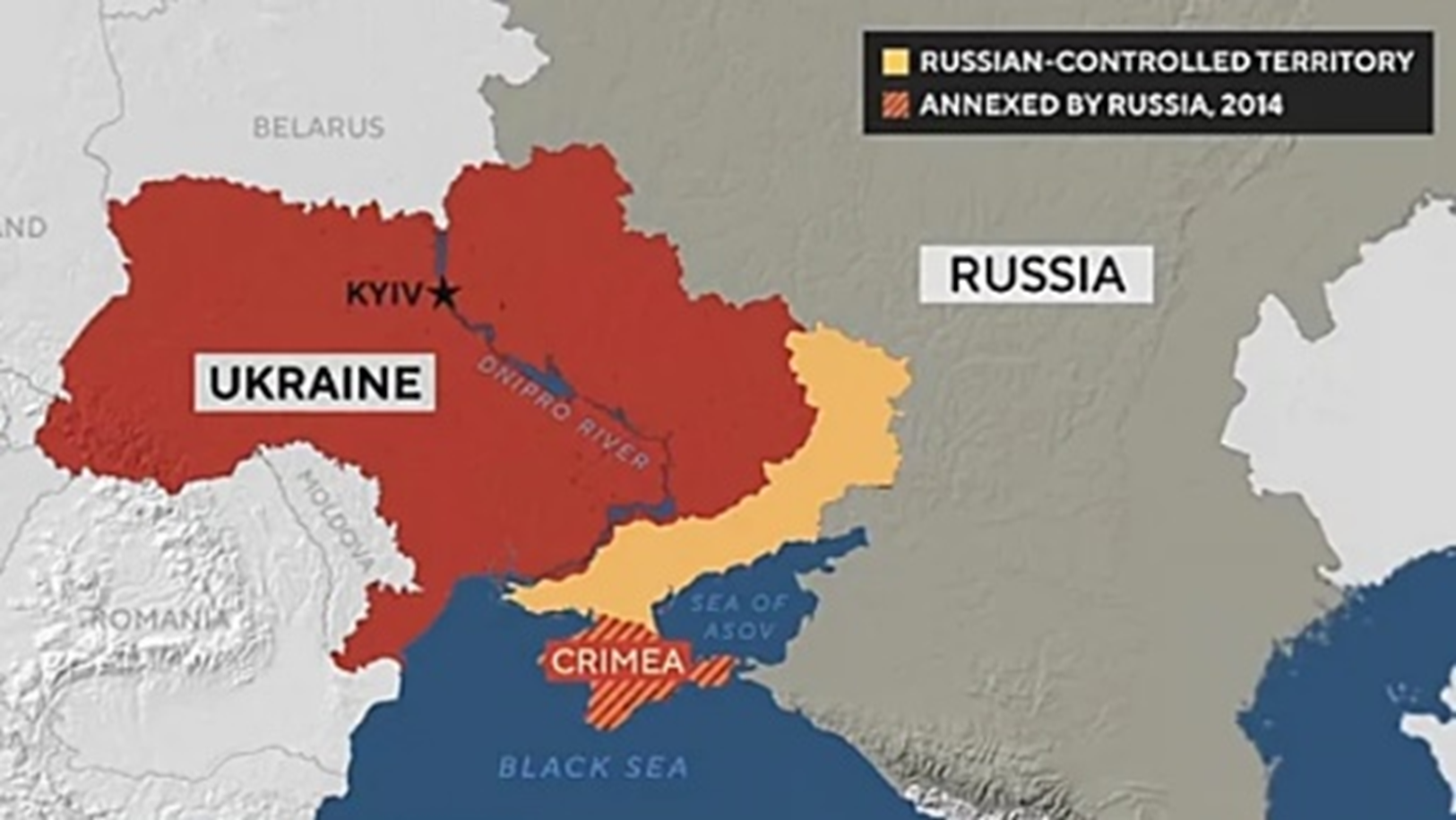 As we addressed in our previous ATW, the war in Ukraine continues with no end in sight. However, there was some good news last week when the European Union signed off on $106 billion in loans, extending a much-needed lifeline to Kyiv. The loan follows recent announcements that Ukraine will jointly produce weapons in allied European countries, including Germany, Denmark, Norway, and the U.K. However, the U.S. had been providing critical systems such as aerial interceptors that Ukraine needs to shoot down Russian ballistic missiles. The U.S. also provides Ukraine’s military with battlefield intelligence. The EU nations cannot provide these systems or the quality of intelligence that has been coming from the U.S., so it will be important to see how much support the U.S. provides Ukraine moving forward. Many of the defensive and offensive weapons systems provided to Ukraine by the U.S. such as the Patriot and HIMARS/ATACMS have been restricted and deployed to the Persian Gulf. With the spring fighting season upon us, Ukraine will benefit from the immediate deployment of funds from the $106 billion loan package, but the question is will this be enough to push back the upcoming Russian offensive designed to capture land in the east that has been annexed (but not controlled) by Russia? Putin has not stepped back from his goal of controlling this territory (among his other demands) and believes time is on his side. With the U.S. focused on Iran, and then likely on Cuba, the initiative for peace talks to continue has largely been put back in Zelensky’s camp as he has tried to engage with the Russian side directly.
“The EU’s approval of a $106 billion loan package to Ukraine demonstrates that Europe’s support for Ukraine is increasing, not declining. It provides President Zelensky the needed leverage to try and stimulate a Ukraine-Russia summit while the U.S. led peace effort has stalled due to the war with Iran. The talks have remained fragile even with Zelensky’s willingness to meet while Putin continues to condition any final agreement on substantial Ukrainian concessions rather than entering reciprocal negotiations. While Ukraine’s military posture is currently its strongest in over a year, Russia appears prepared to prolong the process, anticipating that Western support for Kyiv may diminish over time and yield a more favorable negotiating position. Consequently, the near-term outlook suggests the persistence of the current stalemate and a prolonged, attritional conflict, with limited prospects for meaningful diplomatic progress.” – General Robert Walsh
“The war between Russia and Ukraine has settled into a grinding conflict of attrition, with only limited changes along the front lines and no side positioned for a quick breakthrough. Russia’s industry still allows it to sustain high levels of military spending, but this comes with growing economic strain and rising casualties at home. At the same time, Ukraine has built a surprisingly resilient defense‑industrial base, especially in drones, long‑range strikes, and now counter-drone capabilities. The EU’s new $106 billion loan package gives Ukraine multi‑year financial breathing room and signals that Europe is prepared to carry more of the burden if U.S. support becomes politically constrained. This may reduce Washington’s leverage over Kyiv and could complicate President Trump’s effort to push for a quick settlement before the 2026 U.S. mid‑term elections. If one or both chambers of Congress change hands, lawmakers are likely to resist any deal seen as too favorable to Moscow, even as they push to cap open‑ended U.S. commitments.” – General Steven Basham
“Russia continues to be in the driver’s seat as they watch increased energy prices support their military efforts in eastern Europe. Despite a more cohesive narrative from NATO and Europe, Putin feels less pressure now to come to the table than at any time in the past year. Expect the spring fighting season to be very active, and the targeting of strategic assets (power infrastructure, logistics nodes, and strategic reach capability) by both Ukraine and Russia. With the U.S. absent from the narrative, productive peace talks are a long way off.” – General John Evans
“In the short term, this will be more of the same. Russia’s dependence on Iran and China helps to frame my thinking as Iran is tied up and has a leadership void, and their ability to help Russia (with drones etc.) is greatly diminished and tilts an advantage to Ukraine that will allow them a little more leverage to maintain the status quo. I believe Putin would be ready for an out but there isn’t a clear one in front of him. He certainly won’t accept Zelensky’s offer and make him look like a legitimate leader.” – General Brian Cavanaugh
“I think the Russia/Ukraine war will proceed in 2026 much as it did in 2025. Neither Russia nor Ukraine are in a position where they will, or can, compromise on their war aims. As long as this is the case, there will be no meaningful diplomatic progress. Ukraine has no viable economy. The EU loan will keep Ukraine financially afloat for perhaps 12-18 months, but I expect that Ukraine will start passing the hat again much sooner. Even in Europe, Ukraine funding becomes more contentious with each round. The Russian economy struggles with low growth manifested by high interest rates and an overvalued Ruble. This will not, however, be sufficient to cause Russia to change its course on the war. Militarily, Russia will continue to make slow progress on the ground, focusing primarily on the fortified conurbations of Kramatorsk and Slaviansk which, along with Kostyantynivka in which fighting is currently ongoing, are the last uncaptured major urban areas remaining in Donetsk. The acquisition of Donetsk is one of Russia’s main stated diplomatic aims. Perhaps worth noting is what appears to be a recent hardening of rhetoric coming out of the Russian Foreign Ministry regarding Europe. Russian Foreign Minister Lavrov stated earlier this month that Europe ‘was already at war’ with Russia. While Russia has held the view for some time that Western countries used the Ukraine conflict to run a proxy war against Russia, Russian public comments to that effect seem more frequent and more direct. This might well be the result of a confluence of recent actions which Russia views as directly hostile, including the loan to Ukraine for military aid, the reported funding of that loan through the interest from frozen Russian assets, increased drone support to Ukraine, and the continued efforts to interfere with the shipment of Russian energy products. It is difficult to know whether this hardening rhetoric will result in any additional Russian action but, if Russia is feeling increasingly pressed by these actions, it may take steps to push back, in the form of deniable, ‘grey zone’ actions in peripheral states.” – Neil Wiley, Former Principal Executive, Office of the Director of National Intelligence
“Sadly, the most likely scenario is more of the same as the spring fighting season drags on. Neither side has so far been able to mass enough manpower, drones, artillery, or conventional airpower to achieve an operational breakthrough. Continued Ukrainian drone strikes on Russian refineries, taking down as much as a third of Russian capacity, will exacerbate the domestic fuel situation for Putin with a yet unpredictable political impact (if any).” – General Rick Waddell
China | U.S. Summit
 Last month, the White House announced that China had agreed to postpone President Trump’s visit to Beijing due to the war in Iran. However, both sides were intent on rescheduling it, and as of now, it is set for May 14-15. The sudden diplomatic “thaw” between Washington and Beijing could be a strategic move to secure energy supply chains and mitigate the inflationary pressures that have impacted the global economy since the beginning of the Iran conflict. While the agenda has not been set, the expected topics include the Strait of Hormuz and Iran, Taiwan, and the trade deal between the two nations. However, as we near the summit with no deal in place with Iran to reopen the Strait and end its nuclear program, there is a risk that this meeting gets pushed to the right once again. Does the U.S. potentially lose some leverage in the meeting with China if these issues are not resolved (or much closer to being resolved) prior to the summit? Some believe Xi will use this against the U.S. Others believe the U.S. will leverage these talks to encourage China to push Iran to loosen their grip on the Strait in order to ensure freedom of navigation for all ships, including theirs, into and out of the Strait. The bottom line is that China is the primary recipient of oil from Iran and with the U.S. blockading Iranian ports and interdicting ships in the Indian Ocean bound for China, these actions will start to put pressure on the Chinese economy. Yes, China has vast supplies of oil and can likely make up the balance lost from Venezuela and now Iran, but it will lose some of its discount and be forced to pay higher prices by another party. China’s hand in the negotiation process with Iran is potentially significant and representatives have likely been communicating with both Pakistani mediators and Iran directly. However, the key will be to see how much sway China has in getting the fractured leadership in Iran to negotiate in good faith in order to get the flow of energy and other products moving again through the Strait.
“Both the U.S. and China are building up maximum leverage before the meeting in May. President Trump threatened to impose a 50% tariff on China if Beijing is found to have supplied Iran with weapons. China responded by saying the reports were fabricated and Beijing would respond with countermeasures. Both Trump and Xi are aiming at stabilizing relations to provide relief to U.S.-China trade that has fallen to the lowest level in two decades. Xi has refrained from strong criticism of Trump’s conduct of the war so that the summit, postponed once by the conflict, can go smoothly. Xi wants to protect its economic interests and reduce the pressure being put on China by the U.S. while the U.S. aims to maintain leverage without creating any instability in relations. The talks should result in maintaining the current state of relations that is competitive and tense but limited in a way to not allow them to get out of control and damage economies. Overall, both countries appear intent on managing risk at a time when their respective economies are facing distinct challenges. Consequently, the summit is likely to emphasize optics over substantive outcomes, and significant breakthroughs should not be anticipated.” – General Robert Walsh
“Should the summit occur in mid-May and the situation in the SOH persist until then (which I believe is likely), Xi will undoubtedly attempt to apply pressure on Trump to end the conflict. This is a prime opportunity for President Trump to extract concessions from China on the trade front in exchange for a promise of cessation of hostilities and a return to U.S. ‘legacy’ enduring force levels in the Middle East. No doubt this is why the President elected to reschedule the summit despite U.S. continued military commitment in the Gulf region.” – General John Evans
“China and the U.S. both want this summit to occur and to be a success. Dramatic breakthroughs are not necessary for either side — reducing economic pressure and projecting stability are sufficient for both to claim a win. It may sound glib, but Beijing’s announcement last week that they are going to send two pandas to the Atlanta Zoo is the kind of goodwill gesture that suggests a strong desire to set a positive tone. Beijing’s definition of success is likely grounded in three key areas: economic and trade stabilization, easing technology restrictions, and projecting itself as a responsible global actor in contrast to the U.S. China’s recent comments on the war with Iran have focused on reopening the Strait of Hormuz and ending the U.S. blockade, both of which are in Beijing’s interest. China does not, however, appear willing to use its considerable economic leverage with Iran to calm the situation or publicly call Tehran out for mining the waterway. President Xi will probably avoid pushing for significant changes to the U.S. position of strategic ambiguity on Taiwan at this time. The U.S. Intelligence Community publicly judged recently that China does not have a fixed timeline for unification. President Xi will continue to assert China’s regional prerogatives. Xi will almost certainly voice unhappiness with Japan’s military buildup and recent announcement to begin weapons exports. China asserts that Japan’s military evolution is destabilizing to the region. He may also complain about the ongoing U.S. military exercise with the Philippines. The multinational exercise, which includes 10,000 U.S. troops and for the first time ever troops from Japan, is set to conclude the week before the start of the summit.” – Linda Weissgold, Former CIA Deputy Director for Analysis
“The U.S. – China Summit will be shaped by the ongoing conflict in the Middle East. If the U.S. has not negotiated a settlement with Iran and a blockade remains in place, I expect Xi will press Trump to find a diplomatic solution soonest. China remains dependent on Iran and the Gulf Cooperation Council countries for over 50% of its crude oil imports. Although, it has been able to weather the early days of the Strait of Hormuz closure and blockade, a sustained impasse will start to impact China’s deep reserves. Xi’s confidence about the U.S. embroilment in the Middle East may be tempered by the accumulated economic impact of Trump’s actions in Venezuela, Cuba, and Iran. Trump will likely try to keep the talks focused on trade and not confront China’s relationship with Iran. Xi may not press directly for Trump to walk away from support for Taiwan’s independence and will bide his time longer, perhaps waiting to reassess the way ahead until after Taiwan’s presidential election in early 2028. The blockade’s success demonstrates what the U.S. military is capable of relative to China’s actions against Taiwan and the Taiwan Strait. Bottomline, I think there will be agreement on trade initiatives—reduction in U.S. tariffs, moderation of Chinese restrictions on critical mineral and rare earth exports—but little change on Taiwan or China’s tacit support for Iran.” – Admiral Kelly Aeschbach
“It is quite possible that the U.S. will again seek to postpone the summit with China should the situation with Iran not be resolved and as the U.S. naval interdiction efforts against Iran increasingly target shipping bound for China. The administration will not want to give President Xi the opportunity to pressure President Trump to make concessions to the Iranian regime contrary to U.S. interests and may also want to avoid confronting President Xi on China’s long-standing evasion of sanctions against Iran and its efforts to provide the Iranian regime with intelligence and weapons after Operation Midnight Hammer as well as during the current conflict.” – Joe Zacks, Former CIA Deputy Assistant Director for Counterterrorism
“According to some accounts, China had stockpiled as much as 150 days of crude in their strategic petroleum reserve. Supposedly their LNG storage tanks were also filled before the war. Since China has not been totally cut off from world energy markets, their draw down of reserves can last much longer. Still, early on, China prohibited exports of refined fuels, which had gone mostly to their Asian trading partners. Now China can release refined fuels to those neighbors, posing as their champion. As the major customer for Iran, and its major arms supplier, China has done very little for the Gulf Arab nations in this conflict, but the need for the Chinese hydrocarbons market will weigh heavily on the future relationship. Look for the summit to go ahead even if the U.S. blockade continues, but Xi will argue that he has little influence on the squabbling Iranian leadership, while condemning Japan’s new aggressiveness, making the usual remarks about Taiwan belonging to China and returning to PRC control, and offering merely transactional trade benefits that do not change the structure of the U.S.-China trade dynamics.” – General Rick Waddell
“With the summit back on the calendar, both leaders have an interest in presenting a stable and productive engagement, particularly given the broader geopolitical and economic backdrop. Key issues such as Iran, energy security, trade, and Taiwan will shape the discussion, but expectations for substantive breakthroughs should remain modest. The more likely outcome is a set of signals aimed at reducing immediate tensions and reinforcing channels for continued dialogue, rather than resolving underlying strategic competition. China’s evolving role in the Gulf and its broader positioning amid the U.S. focus on Iran will be an important dynamic to watch coming out of the meeting. I expect stabilization in tone, but no meaningful shift in the underlying U.S. – China competitive trajectory.” – Shelby Pierson, Former Director of Analysis, National Geospatial-Intelligence Agency