
NFP and Plastics
Before we focus on NFP, let’s examine where the Iran conflict is having the most immediate effects.
Chemicals, Jet Fuel, and Diesel
Yes, we all talk about oil – WTI and Brent, but the most dangerous immediate threat to the global economy may be coming from elsewhere.
We have put LNG ahead of Oil on our radar screen, largely due to the fact that oil isn’t as “tight” as LNG. There is more time to solve the situation in the Strait relative to oil, rather than with some other products.
We updated some of this in yesterday’s Spider Web Podcast (ok we didn’t call it that, though maybe we should?). In any case, it is an Iran-focused podcast, featuring Spider Marks.
China restricts exports on diesel, gasoline, and jet fuel.
That was possibly one of the most important headlines yesterday, but the market seemed to largely ignore it. Yesterday’s trading (and so far, today’s) seems to revolve around reality, dragging stocks lower, with the occasional “hopeful” headline providing some relief.
Our view is this will resolve itself within days or weeks, but it is NOT going to resolve itself with wishful thinking. All parties need to be looking for an off-ramp, and the best way for Iran to force the U.S. to “declare victory” and move on with some sort of a deal is to put pressure on energy markets (and increasingly energy by-products).
As we’ve pointed out, China has significant stockpiles of crude. They have been “preparing” for such a day. Some estimates are that they may have half a year’s worth of supply.
Yet they chose to restrict exports of refined products? Is it necessary, or is this their way of inserting themselves into the U.S. and global calculus? I probably shouldn’t bring up ProSec™’s focus on refined, processed, and smelted commodities, but it seems salient to what is occurring.
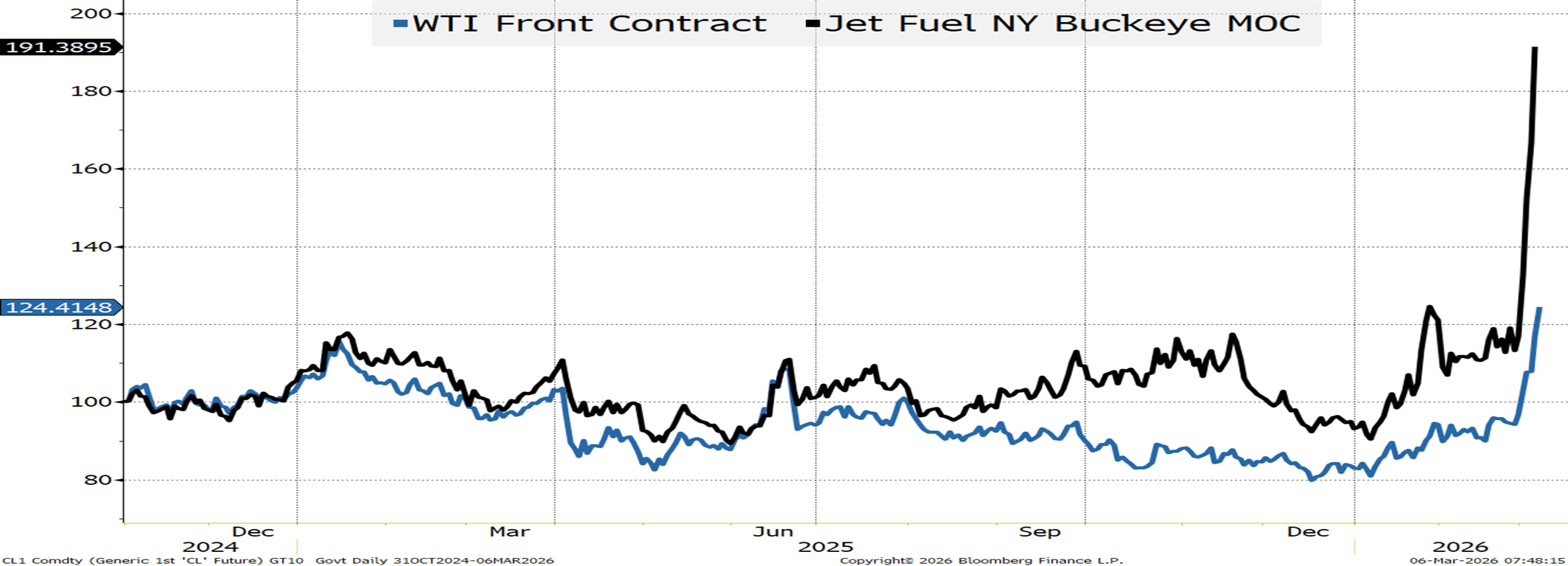
I am not sure what the best metric is for jet fuel (this seemed semi-reasonable in a rush), but I am told that we could have major issues as early as next week, as the combination of Iran and China restrictions could take an immediate toll.
The Asian Petrochemical Industry
I have one word for you – “plastics.” I had to work in Mrs. Robinson somehow.
I apologize for the lack of links but have been having all sorts of issues with my internet and computer (typing on the train never helps).
According to Bloomberg reporting, India’s state-run Oil and Natural Gas Corporation, Ltd. is facing a shortage of feedstock.
Suppliers of ONGC Petro additions Ltd. issued a force majeure, linked to a shortage of liquefied natural gas (LNG has been at the top of our concerns).
Per Bloomberg: ONGC Petro additions Limited produces and supplies petrochemical products. The Company offers polymers, propylene, benzene, and ethylene products. ONGC Petro additions serves the petrochemical industry worldwide.
If you are on a Bloomberg terminal, type NI CHEM go. Then do a search on force majeure. It has always been one of my favorite terms in finance, but it is a bit scary.
Today’s top story is “Indonesia Petrochemical Giant Declares Force Majeure.” I did double check, it’s not India, but Indonesia. There are more than 30 stories (using my settings) in the past couple of days that have come up under this search. There were a handful back in January (just trying to confirm that this isn’t the “norm”).
It seems that many petrochemical producers in Asia (outside of China) do not have the inputs they need to produce the compounds that are needed further up the production chain.
The biggest threat to the global economy may in fact be “Plastics.” Mr. McGuire may have been right all along.
If we don’t get any resolution over the weekend, we could see ethylene, propylene, benzene, methanol, and other names become household words. Which would make my father, an organic chemist, very happy!
NFP – So Bad It Cannot Be True?
At first glance, this report was so awful that it cannot be true.
Headline jobs: 92k job losses. Almost all of the losses in the private sector.
Revisions: -69k.
Labor Force Participation Rate: 62%. I know it doesn’t work, but I flicked my screen with my finger, thinking maybe if I just jostled the screen a sensical number would come up! Though it must be “sensical” since last month’s participation rate was “only” 62.1% (instead of the initially published 62.5%).
Weather has to have had an impact. (Does immigration play a role in any of these numbers?)
The unemployment rate.
We had a 0.5% decline in labor participation from what was originally published last month, to this month.
Yet the unemployment rate only went up 0.1% to 4.4%.
So, the first thing I did was check the Household data (because that is what is used for unemployment).
The report shows 185k jobs were lost in February.
So, I glance at the January Household Survey number: -895k jobs.
The Household Survey has lost 1 million jobs in 2 months. But I swear even I would have caught such a big number in January.
On February 11, when we got the report, January Household employment was 528k.
The Household data is notorious for its massive margin of error, but it looks like we quietly revised down 1.4 million jobs?
I am sure there are weather factors. With so many other potential “garbage” inputs, which were only made worse by the government shutdowns, I will take this report with a grain of salt.
Bottom Line
My bigger concerns coming into the weekend, for next week:
- Can we get a deal of some sort to get oil flowing again in the Middle East?
- I suspect all parties are looking for an off-ramp, though not sure there is anyone truly in power in Iran to negotiate any such deal.
I want to be fairly neutral rates and risk at the moment.
- If we get some sort of a “deal” with Iran, equities, and bonds rally strongly Monday.
- No deal, we face a down market (though one that will be subject to “hopeful” headlines).
Probably “slightly” biased to be positioned to the risk-off side of fairly neutral, especially if no one comes up with a really good explanation for why this month’s job report was so dreadful (pretty much across the board). What does scare me is that last month’s headline number was only revised down by 4k and still sits at what might be a mythical 126k.
I will be booking some flights just in case jet fuel keeps going higher!
I also want to wish all of our service members the best in these difficult and dangerous times.