
Academy SITREP – U.S. Strikes Iranian Oil Tankers
What has Happened:
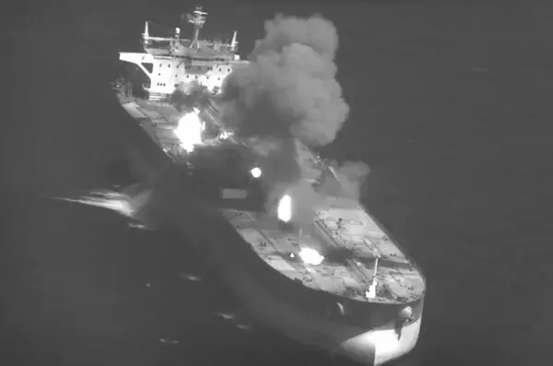
- Last evening, U.S. forces destroyed five Iranian oil tankers in response to recent attempts to attack U.S. warships with ballistic missiles.
- CENTCOM declared that the sunken vessels were part of the multibillion-dollar shadow network used by Iran to fund the IRGC and its regional proxies.
- The IRGC also threatened to attack oil tankers docked at Kuwaiti and Bahraini ports, explicitly warning civilian crews in those areas to evacuate immediately.
- This morning, Jordan said its military intercepted 18 Iranian missiles targeting U.S. bases and reported no casualties.
- Following these attacks, in an effort to further pressure the U.S., Iran has signaled that it is willing to escalate its fight with the United States (potentially leading to unintended consequences).
- Iran also announced plans to establish a strict “maritime exclusion zone” extending through the Strait of Hormuz into the Gulf, declaring the area off-limits to unauthorized transit.
- This week, the Iranian government raised some gasoline prices because of fuel shortages, a move that is expected to create further problems for Iran’s economy, which is struggling with soaring inflation, higher unemployment, GDP contraction, and a rapidly depreciating currency.
- Iran’s new terms for ending the ongoing conflict with the United States and Israel require a complete halt to U.S. military action, the withdrawal of Israeli forces from Lebanon, an end to regional blockades, the release of $24 billion in frozen assets, and non-interference in Iran’s nuclear and missile programs.
- Adding to the pressure on energy prices, Houthi attacks yesterday targeted four southern Saudi cities (Abha, Jazan, Najran, and Khamis Mushait), igniting fires at key utilities and state-owned Saudi Aramco energy facilities.
Why it Matters:
“Iran’s regime has demonstrated a significant capacity to absorb economic hardship after decades of sanctions, adapting through sanctions-evasion mechanisms, shadow shipping networks, ship-to-ship transfers, alternative payment systems, and a willingness among some buyers to purchase discounted Iranian oil. Nevertheless, the economy remains vulnerable because oil exports are its primary source of hard-currency revenue. Militarily, Iran can sustain a prolonged low-to-medium intensity confrontation and continues to pose a credible threat to commercial shipping, U.S. regional bases, and U.S. naval forces through asymmetric tactics, drones, and missile capabilities. However, Iran lacks the conventional military power necessary to challenge or defeat U.S. naval forces in a direct conflict. Iran appears willing to continue escalating attacks to impose greater economic and military costs on the U.S. and its partners. As a result, the risk of further escalation remains elevated, with both sides responding to provocations with increasingly forceful measures. Iran’s maritime targeting capabilities have been degraded by damage to key radar and surveillance networks, increasing its reliance on external intelligence support, including likely space-based sources. At the same time, U.S. naval forces retain significant advantages in maneuver, electronic warfare, emissions control, and deception techniques, which reduce the effectiveness of even Iran’s more advanced anti-ship missile systems. While newer Iranian anti-ship ballistic missiles have increased the threat environment for U.S. warships operating in the Gulf of Oman, they have not fundamentally altered the military balance. The U.S. strategy of targeting Iran’s oil tanker fleet and broader export infrastructure remains in its early stages but is already imposing meaningful financial pressure on Iran’s shadow oil-export network. Tehran is likely to respond with additional attacks before reconsidering its approach. Overall, the U.S. strategy of combining sustained economic pressure with selective military action appears to be gradually increasing costs for Iran, although its ultimate effectiveness will depend on whether those costs eventually outweigh Iran’s strategic objectives.” – General Robert Walsh
“As many here predicted, this exchange is the latest in a series of periodic spasmodic events we should expect. The history of Middle East ceasefires teaches us this. If CENTCOM statements are in any way accurate (and I trust them), then substantial crude oil is flowing through the southern Omani route. What is not apparent is whether Gulf LNG and refined products are also flowing. One of the tankers presumably hit by the IRGC was in Iraqi waters and another was an LNG carrier in Emirati waters. This indicates that the Gulf states and tanker owners are willing to risk shipments. Meanwhile, the CENTCOM response of hitting the Iranian shadow fleet will have much longer-term consequences for the IRGC and whatever passes for the Iranian regime, because normal shipping companies are susceptible to sanctions whenever the U.S. blockade is lifted. Just a few weeks ago, there were many comments about the longer-term damage that could occur if Iranian crude production was shut in. That damage would now be occurring as onshore and offshore storage should be full to overflowing. Expect more IRGC spasms as they re-arm and seek to maintain some influence over Hormuz shipping.” – General Rick Waddell
“I expect things to continue much as they are through the mid-term election. We will see an environment characterized by no significant diplomatic movement, and punctuated by occasional bouts of violence. Iran doubtless understands that the combination of extreme economic pressure and military containment creates a situation which, if unaltered, it ultimately cannot withstand. The question is really more one of timing. The outcome of a given trajectory is much more predictable than the timeframe in which that outcome manifests itself. The U.S. clearly wanted a quick resolution. That did not happen. Achieving its desired outcome, now, requires maintaining the current, or indeed an intensified, level of pressure on the Iranian regime. Doing so, however, comes at a cost in global market stability, domestic and international political support, and, perhaps, overall military readiness. The Iranian regime will, I think, have two proximal goals. First and foremost, as many have observed, is to remain in power. The second, enabling the first, is to somehow disrupt or weaken the economic and military pressure on the regime. The regime, in my view, must maintain the reality of internal control, and the appearance of an external potency. To this end, they will aim to portray Iran as a functional state capable of managing and withstanding the domestic economic crisis, while simultaneously attempting to strengthen the narrative that it can exert meaningful control over energy and commodity flows in the region. Ultimately, this remains an endurance competition in which the U.S. attempts to maintain pressure long enough to drive fundamental internal change in Iran, while Iran will try to hold out until something forces the U.S. to ease off. I do not think that time is on Iran’s side. If nothing changes, the Iranian regime will eventually crack. Iran, therefore, has to alter the trajectory. Further, Iran may calculate that its best opportunity to alter that trajectory lies in the run-up to the U.S. mid-term elections while the domestic political implications of an unresolved conflict are very much in play. I do not, therefore, expect Iran to remain passive. I think they will continue to take action in an effort to demonstrate that the U.S. is not in control, that the conflict is very much unresolved, and that the market ramifications of that conflict remain very real.” – Neil Wiley, Former Principal Executive in the Office of the Director of National Intelligence
“There is no easy button that will resolve this conflict, and periodic kinetic exchanges will continue. The U.S. must stay the course amidst the economic pressure of oil peaking again at $100 a barrel. What is unknown is the Iranian breaking point, but there is one. All U.S. and allied/partner national instruments of power must be synchronized; however, the economic line of effort is ultimately what matters when the IRGC and the senior leadership can no longer get paid and Iranian strategic calculus that they can outlast the U.S. proves to be a false planning assumption. Domestic instability is also problematic to predict given the regime doesn’t hesitate to kill their own people. In the interim Iran will respond kinetically to pressurize the region and by extension the global economy. The U.S. and our allies/partners (globally and regionally) need to continue to reinforce their ability to defend against Iranian attacks stretching from the Strait of Hormuz to the Bab Al Mandeb and punish Iran as we have over the past week. Iran must be convinced we’re not about to back down and they are assuming that is the case with our elections pending. Reinforcing our defensive position and tightening the economic noose will continue to weaken the regime. We simply need to be unequivocal in executing that strategy and keep our allies informed and engaged.” – General Robert Ashley
“I think we should expect to see more of the same as Iran feels the squeeze of the blockade and the sanctions. CENTCOM has been successful in improving ship movement through the Strait of Hormuz. Iran is likely trying to maintain its leverage over the Strait and execute an impactful hit on the U.S. by targeting U.S. warships. Although unlikely given Iran’s diminished targeting capability, a successful strike on a U.S. warship would be very significant ahead of U.S. elections. A diplomatic solution between now and the elections is unlikely. The risk of escalation remains high as Iran holds out for its steep demands. I think they are confident they are just one strike away from raising the cost of the war in terms of gas prices and human loss beyond the administration’s tolerance to stay the course long term.” – Admiral Kelly Aeschbach