
Academy SITREP – U.S. Expected to Conduct Strait of Hormuz Transit This Month
What has Happened:
- General David Bellon from our GIG believes that a U.S. destroyer-led freedom of navigation “show of force” operation will take place within the next two weeks, and possibly as early as next week.
- Please see this (link) for General Bellon’s presentation to CalPERS earlier this week where he highlights his expectations regarding the potential timeline.
- The Pentagon has deployed the 31st Marine Expeditionary Unit (MEU), a three-ship Amphibious Ready Group (ARG) including about 2,200 Marines, to the Middle East.
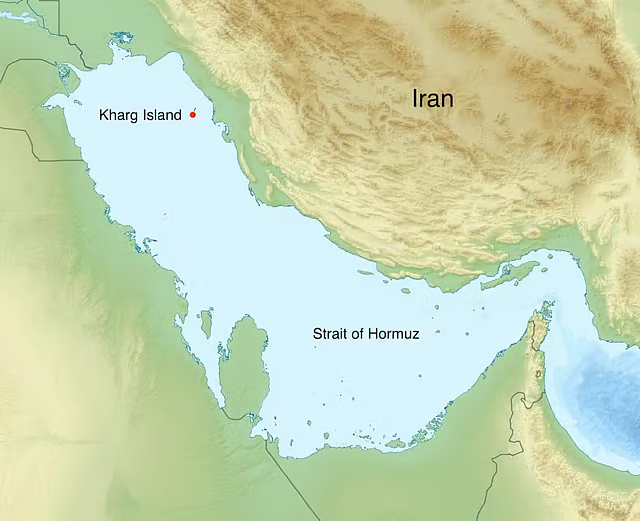
- The U.S. could use the unit to seize one or more of the islands off the southern coast of Iran to use as leverage or as a base to counter Iranian attacks on commercial shipping.
- The ARG is expected to arrive on station in the North Arabian Sea as early as the end of next week, and will join the USS Lincoln Carrier Strike Group, as well as components of the USS Ford Carrier Strike Group operating in the region.
- The ARG includes a ground combat unit, an aviation unit (including MV-22 Osprey tilt-rotor aircraft, attack/transport helicopters, and fighter aircraft such as the F-35B), a command team for coordination, and a logistics battalion that provides essential support.
- On Tuesday, the U.S. military dropped 5,000-pound, deep-penetrator munitions on underground Iranian sites along the coastline that are used to store anti-ship missiles and is conducting suppression operations using A-10 aircraft as well.
- The ARG could be used to help secure Qeshm Island, where Iran can deploy remaining naval vessels and missiles stored in underground tunnels.
- Before any potential operation to seize Kharg Island can begin, the Strait will have to be secured to a point where U.S. Navy DDGs as well as the ARG can transit safely, which would be the pre-cursor to escorting tanker traffic into/out of the Persian Gulf.
- U.S. destroyers will play a large role in demonstrating freedom of navigation and are expected to commence these operations once the coastal defenses have been suppressed to a level where it is safe to make more frequent transits.
Why it Matters:
“It will take a week to 10 days for the ARG and the MEU to arrive in the North Arabian Sea. What happens next depends on whether or not we are able to secure the Strait during that time. If we believe that it is safe enough to pass the MEU through the Strait, we will do it. The reason we would want to pass the MEU through the Strait of Hormuz is twofold. The first is to better maneuver and position the MEU for employment throughout the Persian Gulf. The second is it sends a massive strategic message to the world about the Strait being navigable and it creates pressure on the remainder of the IRGC. If the Strait is not safe enough to pass the MEU through, they could still use the V-22 that has the range to operate as far as Kharg Island at the north-end of the gulf. However, the medevac and casually evacuation scenarios from there would be much more difficult. In addition, it would be difficult to use the organic assault support aircraft like the Cobras to support the Marines on the ground on Kharg Island if the MEU remains in the North Arabian Sea.” – General David Bellon
“Timing for escorts in the Strait are hampered by two factors: 1) The current level of commitment of U.S. naval assets to continue the pressure campaign to provide strike, refuel, reconnaissance, and protection missions and 2) the risk of losing a high-value asset (and suffering a strategic information campaign failure) should the Iranians successfully interdict passage with anti-ship missiles, mines, or underwater unmanned vehicles (UUVs). These limitations are one reason the administration is pressing for naval partnerships to ‘share the risk’ and raise the geopolitical risk for Iran. Although the MEU comes with more staying power than special operations forces (SOF), SOF has the capacity and capability in theater to execute the seizure of Kharg if that becomes a time-sensitive objective for the campaign. Post-seizure and upon arrival, the island would likely be handed over to the MEU.” – General John Evans
“Iran remains recalcitrant, striking Israel and Qatar oil facilities today in retaliation for yesterday’s Israeli strikes on South Pars. U.S. strikes continue to focus on eliminating any Iranian military capabilities that could threaten shipping in the Strait of Hormuz, but Iran likely still retains some missiles, drones, fast attack craft, and mines. I think the bar on conditions to move a carrier or ARG into the Gulf is likely very high and will require at least 3-4 more weeks of strikes to achieve. Another consideration in the timing of sending any U.S. ship through the Strait of Hormuz and/or initiating an island seizure is the availability of the USS Ford. She is headed to Souda Bay for repairs following a fire onboard and will not be available to support ongoing strike operations for several days. The U.S. will likely want the Ford back underway or the Bush on station to support operations if they expand beyond strikes.” – Admiral Kelly Aeshchbach
“Any convoy operation would require especially robust protection against a multi-domain threat set that includes drones, missiles, any surviving coastal defense cruise missiles, and potentially mines. Escorts would need to defend not only against close-range maritime threats, but also longer-range strike systems launched from Iran’s interior. Also, vessels could be vulnerable for the entirety of their time in the Gulf, not merely during transit through the Strait of Hormuz. This means there is still likely work to be done to suppress remaining Iranian fires before convoy operations can begin. Finally, the decision to sail, escorted or not, is ultimately a commercial business decision, not a political one. Commercial entities will want more than naval protection alone; they will also look for confidence-building and de-escalatory diplomatic or political steps that suggest the risk environment is genuinely improving. Naval escorts could make transit possible, but that doesn’t automatically mean it will be commercially acceptable.” – General Karen Gibson
“In Iraq, after we took Umm Qasr, and completed our mine clearing efforts, we ‘compelled’ three merchant ships to pull anchor and go through the waterways validating that we had minimized most of the risk. The same sort of strategy would be effective here. On a separate note, I remain concerned about the Bab al-Mandab as well, as the Houthis have demonstrated their ability to target ships there.” – Admiral Robert Harward