
Academy SITREP – Trump Meets with Zelensky and European Leaders
What has Happened:
- Last Friday, President Trump and Russian President Vladimir Putin met in Alaska for a high-stakes summit on ending the war in Ukraine.
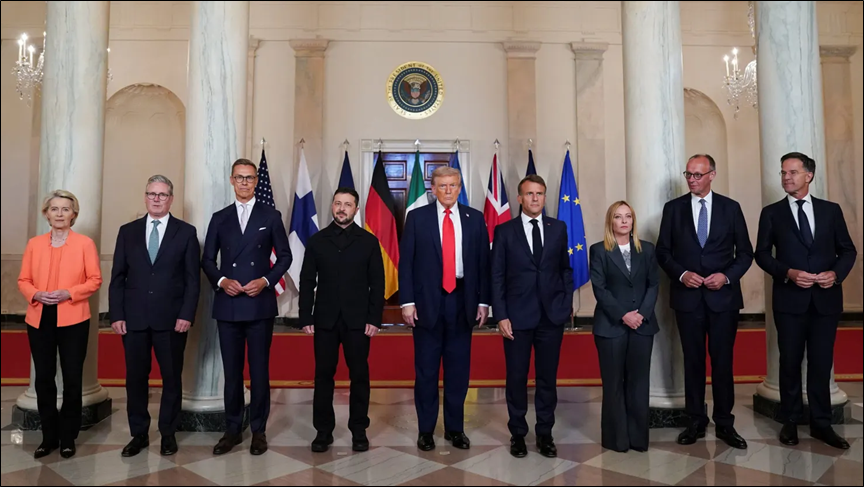
- On Monday, President Trump hosted Ukrainian President Zelensky and European leaders at the White House to discuss the path forward.
- During remarks alongside the European leaders, Trump said security guarantees were discussed.
- During the meeting yesterday, Trump called Putin to push for a bilateral meeting between the Russian President and Zelensky.
- NATO Secretary General Mark Rutte said that Trump’s offer of security guarantees for Ukraine amounts to a “breakthrough” in securing a potential peace deal for Ukraine.
- The details of the security guarantees are still being debated, as is what land could be exchanged following the end of hostilities.
- However, today, President Trump ruled out sending U.S. troops to help enforce a potential peace deal.
- Putin’s proposal that was outlined last week (which was immediately rebuffed by Zelensky) included a Ukrainian surrender/withdrawal from the eastern Donbas region and in exchange, Russia would freeze the conflict along the current contact line in Zaporizhzhia and Kherson.
Why it Matters:
“Wars end when both sides no longer see value in continuing the carnage and are willing to quit the destruction. Putin is not there yet and sees benefits in continuing. It will take intense pressure by President Trump and the Europeans to change his calculus and bring him to serious negotiations that lead to Russian concessions. Putin’s meeting with Trump in Alaska was another delaying action to a ceasefire or a final peace settlement. He has been on this path to stall a final peace solution with the Trump administration since the first phone call with Trump on February 12. His ultimate objective is to make Ukraine a Russian client state and short of this, enable future Russian attacks that pull Ukraine into Russia’s sphere of influence. He will use the current negotiations to delay and buy time for his ongoing ground offensives and air attacks on Ukraine’s infrastructure and population. He wants to break Ukraine or set himself up for a stronger negotiating position. He is pressing his battlefield advantage during this negotiating window to make further territorial gains until Trump cracks down with tariffs and sanctions that makes the pain so difficult that he must seriously negotiate an end to the war. After Alaska, it does not appear that he has any near-term intent to change his objectives. Alaska must be looked at as a start to serious negotiations and not a failure by Trump. Negotiators must meet to find a solution, and Friday was a start by Putin and Trump meeting face-to-face. Trump left the meeting and said that Putin does not want a ceasefire, but instead is only willing to negotiate a final solution. The challenge for Trump, Zelensky, and the Europeans is Putin will use this time to continue his aggression and gain a stronger negotiating position. It also appears that Putin was successful in delaying further U.S. secondary tariffs. Trump’s secondary tariffs on India helped bring Putin to the Alaska meeting.” – General Robert Walsh
“It was surprising that POTUS did not hold the line on a ceasefire, his strongest ‘card’ to play. The best course of action at this point is to consider NATO/European unity to stop Putin from achieving the fruits of his aggression. President Zelensky will not yield on Ukrainian sovereignty, and the idea of swapping land that the Russians have not actually seized through violence would seem anathema to all of Europe. Lessons for Europe in ‘appeasement’ have not reflected well in the face of history. While the Europeans will seek security guarantees for Ukraine and preservation of its sovereignty, it seems POTUS is already ready to ‘walk’ on this deal. It would be a high bar to establish any ‘NATO Article 5’ similar deal, and not one the current American administration (nor many of the allies) would sign up for. Ukraine and its supporters can look forward to an accelerated unconventional campaign by Russia’s intelligence and sabotage organizations. Without Western strength and Presidential leadership brought to bear, Europe will have to cope until Putin is no longer in the picture.” – General Michael Groen
“It was refreshing to hear a positive tone from President Trump as he emerged from his point to point meeting with President Zelensky. President Trump said that a tripartite meeting is a matter of ‘when not if.’ Despite this comment, he may find it harder than he thinks to get Putin and Zelensky in the same room. Zelensky’s reticence to discuss the forfeiture of Ukraine sovereign territory remains a sticking point (from the Russian perspective) and may well give Putin an excuse to further delay. Meanwhile, Russian offensive operations continue unabated to both embarrass NATO and Ukrainian allies, and demonstrate Russian resolve. I believe a three party meeting in the next 30 days between Trump, Putin, and Zelensky is a long shot.” – General John Evans
“If there are some security agreements emerging, we may see an offer, if not a demand, to Zelensky and the other European leaders to freeze the conflict in place with strong security guarantees that seek to preclude any near-term hostilities by Russia. The security agreements would be outside the framework of NATO membership. Trump seems laser focused on stopping the killing. The logic may be that it’s a better outcome for Ukraine to be able to flourish with 80% of their original territory vice continuing to fight a conflict that is likely to continue for at least another year if not longer and look for opportunities to regain some territory over time as did Finland after the end of the Winter War in 1940. Over time Finland, which signed an agreement favorable to the Soviet Union, did regain some territory and flourished in the interim.” – General Robert Ashley
“Pundits, who are trying to label the Alaska Summit as a failure because a ceasefire was not achieved, are making a premature call. Achieving a tactical ceasefire was a long shot that seems to have been sacrificed for the strategic goal of potentially bringing Russia and Ukraine to the negotiating table. A tripartite discussion—Presidents Trump, Putin, and Zelensky—would be a significant achievement that could ultimately result in progress towards peace even without a preliminary ceasefire. While it is almost certainly correct to say that Putin believes continued fighting enhances Moscow’s position in any future negotiations, a bloody Russian push to take even more territory as quickly as possible could backfire—angering the U.S., hardening Ukrainian resolve and requirements for security guarantees, and energizing European allies. I agree with General Walsh that it will take intense pressure by the U.S. and the Europeans to change President Putin’s calculus and gain concessions, but it will also take significant assurances from those same parties to get Ukraine to sign on any dotted line.” – Linda Weissgold, former CIA Deputy Director for Analysis