
Academy SITREP – Houthis Escalate Attacks Against Saudi Arabia
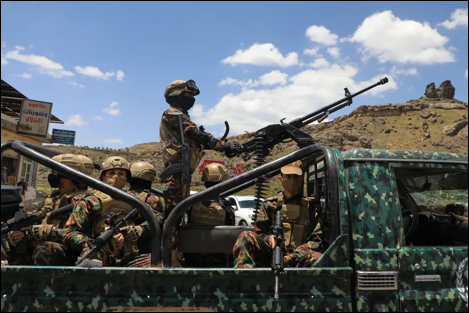
What has Happened:
- Over the weekend, Iran-backed Houthi rebels launched ballistic and cruise missiles (along with drones) targeting the Saudi capital of Riyadh.
- Saudi air defenses successfully intercepted a ballistic missile, though damage was done to King Khalid International Airport’s fuel storage area.
- The fighting between the Saudis and the Houthis reignited in July after a Houthi delegation returned from Iran.
- Saudi-backed forces bombed the runway at Sanaa’s airport, and the Houthis responded with drone and missile strikes on Saudi infrastructure and declared a maritime blockade.
- However, the Houthis have said that the blockade is explicitly targeting Saudi-linked vessels and promised they would uphold their 2025 ceasefire agreement by not attacking U.S./other countries’ commercial ships.
- In the last two weeks, the Houthis have advanced down Yemen’s west coast and captured the key port city of Mokha and the strategic island of Perim, giving them some control over the critical Bab al-Mandeb Strait.
- While Crown Prince Mohammed bin Salman has requested U.S. air strikes against the Houthis to stop the rapid advance, the U.S. has (for now) not moved forward with strikes.
- Meanwhile, President Masoud Pezeshkian will lead an Iranian delegation at the United Nations General Assembly in New York on Tuesday.
- The hope is that continued application of U.S. economic pressure, coupled with threats of further strikes, will help drive a diplomatic end to the Iran conflict.
- In addition, all eyes will be on the Trump/Xi summit this week for any signs that China will help deescalate the Houthi conflict and help push Iran back to the table for talks.
Why it Matters:
“The Houthis’ success in seizing Mokha and several islands near the Bab al-Mandeb gives them significant advantages. They control Yemen’s entire Red Sea coast and ports, from which they can better observe, threaten, and interdict shipping. They may say that non-Saudi ships are free to sail, but they have implicitly established themselves as the authority whose permission matters. In short, the Houthi presence is now a factor in every transit decision. They also managed to boot the opposition from their headquarters, logistics hub, and sole port on the Red Sea, capturing many useful weapons in the process. This represents a dramatic loss for the fractured opposition, who will face a steep uphill battle to recover the terrain. This is especially bad for the Saudis, since all their petrochemical transit options are now at risk, whether due to Iranian activity near Hormuz, Houthi interdiction in the Red Sea, or drone attacks against gas and oil infrastructure (in another wrinkle, it’s not just the Houthis who are attacking, but also Iranian-aligned militia groups operating from Iraq). This not only harms their economy but also distracts from programs intended to transform the kingdom from a petrostate into a regional hub for transit, tourism, and economic security. What can be done? The Houthi dream is territory and control of Yemen. Cash won’t buy them off indefinitely. They must be defeated militarily, and this has to be done on the ground. Air strikes alone will be insufficient to dislodge the Houthis from Mokha or Hudaydah, yet the Saudis are understandably loath to employ ground forces against them, and I doubt our President wants to open a second air or naval front in the Middle East. Going forward, we should watch the Saudi military and diplomatic reactions (they almost certainly have back-channel comms with Iran, the only player with any levers or influence at all over the Houthis); Houthi next steps regarding shipping, ground offensives against the opposition, and aggression directed at Saudi Arabia; and the response of the commercial shipping industry. For now, it’s fair to say that the Bab al-Mandeb is technically open, but commercially impaired. Houthi, Saudi, U.S., and Iranian actions over the coming weeks will show whether this is just a temporary disruption or becomes a more enduring security and transit issue.” – General Karen Gibson
“The U.S. can ill afford a two-front conflict in the Middle East. The purposeful restraint by the Houthis in not overtly targeting U.S. assets will continue to keep the U.S. on the sidelines and out of active conflict in the Red Sea and Arabian Peninsula. I expect diplomatic approaches to continue with Yemen, Saudi Arabia, and (to a lesser degree) the Houthi rebels. No doubt MBS is putting pressure on the U.S. to do more (a quid pro quo for the tacit support the Saudis have provided in Epic Fury), but China may yet play a larger diplomatic and pragmatic role in pressuring the Houthis to stop attacks on oil infrastructure.” – General John Evans
“Yemen is a perennial form of quicksand for Saudi Arabia, and while there may be U.S. opportunities to help deescalate the current shipping crisis, the Houthis have essentially shown that they have the ability to inflict significant cost on Saudi Arabia and the world. They are not going to give up that power without reaping significant benefits. For roughly a quarter of the last hundred years, Saudi Arabia has been involved in military conflicts in Yemen. The difference this time around is that the Houthis are threatening Saudi energy export routes and the fight has become embedded in the much larger Iran-Gulf-Red Sea-Hormuz conflict. It is possible that Saudi Arabia will try to use UN week to gain greater international support, but unlike their intervention in 2015, when they were able to reasonably claim that their objective was to restore the internationally recognized government of Yemen, that ship has sailed. Nobody has confidence that the fragmented anti-Houthi camp can reassert its control. Any appeals to the international community will have to be made on the basis of keeping the Houthis from threatening the international oil-export system. Getting any sort of coalition willing to actually commit forces would be extraordinarily difficult without a U.S. leadership role. So, it all may come down to how much economic pressure Riyadh is willing to put on Washington.” – Linda Weissgold, Former CIA Deputy Director for Analysis
“The Houthis’ seizure of Mokha and islands at the mouth of the Red Sea is significant. Both the Strait of Hormuz and Bab al-Mandeb are now threatened by Iran or an Iranian proxy, directly impacting Saudi Arabia’s ability to keep its oil flowing out of the region. The Houthis will likely lean into the advantage they have gained to get concessions they have been seeking from Saudi Arabia. This administration is loath to open another front in the Middle East and will likely seek to provide quiet support to Saudi Arabia to resolve the situation. I think we will stay the course with the blockade, especially since CENTCOM continues to have success in facilitating ship transits through the Strait of Hormuz. It remains to be seen if Iran takes an opportunity to pressurize concessions to their demands now that two vital maritime chokepoints are under their influence.” – Admiral Kelly Aeschbach
“The refusal to attack the Houthis by POTUS is consistent with his view that allies/partners need to do more to take care of themselves. We’ve spent five decades diligently building up Saudi forces. They have (on paper) hundreds of combat aircraft and substantial proxy forces on the ground in Yemen. The Kingdom also has a mutual defense pact with Pakistan. It should, therefore, not be surprising that the American answer was to offer help with intelligence feeds and targeting to enable the Saudis to act in their own interests with their own resources.” – General Rick Waddell