Academy SITREP – U.S. Strikes Iranian Targets over Ceasefire Violation
What has Happened:
- This evening, the U.S. military conducted strikes against Iran in response to what President Trump said was Tehran’s violation of the ceasefire.
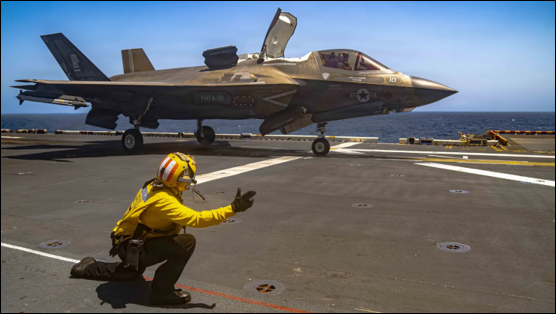
- According to CENTCOM, U.S. military aircraft struck Iranian missile and drone storage locations and coastal radar sites around the Strait.
- The IRGC attacked a Singapore-flagged commercial vessel (M/V Ever Lovely) in the Strait of Hormuz with a drone on Thursday.
- Iran’s Persian Gulf Strait Authority said that “Any passage through routes outside the framework designated by PGSA will not be covered by safe passage guarantees and will not be entitled to insurance coverage or related liabilities.”
- The U.S. and Iran agreed on June 17 to end hostilities under a 14-point Memorandum of Understanding, which had also called for Iran to use its “best efforts for the safe passage of commercial vessels with no charge for 60 days.”
- A direct communication line had been established this week between Iran and the United States in the Strait of Hormuz to prevent this kind of escalation.
- Meanwhile, Secretary of State Marco Rubio announced the framework of a deal between Lebanon and Israel, but Hezbollah, which has rejected similar past deals, was not part of the negotiations.
- As the talks began in Switzerland this week, Vice President Vance said that Iran agreed to allow international inspectors to return to its nuclear sites as the broader negotiations continue, though Iran has denied any commitment had been made.
Why it Matters:
“First, I think Iran’s drone strike against the Singaporean-flagged vessel was meant as a coercive act designed to demonstrate Iran’s continued leverage in the Strait and reinforce the point that Iran intends to play a role in managing maritime traffic. They object to the joint U.S.-GCC statement calling for ‘free, unconditioned, and unrestricted navigation’ through the waterway. They seek instead to establish a new navigational order on Iranian terms, repeatedly stating that ‘coordination is mandatory.’ I do believe Iran miscalculated, wrongly assuming that their drone strike would send a signal without inviting retaliation if it was not lethal or did not directly affect American interests. Will this derail negotiations? There are already so many challenges inherent in these talks that it’s hard to say to what extent this prolongs or derails them. Negotiations aside, it undermines efforts to return to normal commerce and navigation in the Gulf. Shipping firms and their insurers must believe that safe transits will be ROUTINE, not episodic. This doesn’t help. Yesterday’s strike on a commercial vessel should put to bed any belief that Iran is sincere in its commitment to negotiate in good faith on the terms established in the MOU.” – General Karen Gibson
“Expect more of these types of events in the coming weeks and months. I do not assess these strikes will completely derail talks, but they are a reminder that the ceasefire remains fragile and that Iran cannot be trusted. Both sides are likely to execute measured responses to future incidents without seeking a return to full-scale conflict. Iran sees the United States as vulnerable to global economic pressure and is testing the waters—literally—of its leverage to establish a new norm. The Strait of Hormuz is an international waterway, and placing tolls on passage would violate the United Nations Convention on the Law of the Sea. Iran is seeking to change facts on the ground, which represents a red line not only for the United States and regional Arab nations, but also for the international community. I would expect other MOU-related economic incentives proposed to continue in closed talks as a means of keeping the ceasefire in place and moving on to longer-term issues related to Iran’s nuclear program. At best the situation will remain highly volatile and be subject to ongoing setbacks and kinetic exchanges.” – General Robert Ashley
“It’s likely the Iranian drone strike on the Singapore-flagged cargo ship served two purposes: 1) a strike to test U.S. resolve in light of what Iran perceives as vacillation by the Trump administration, and 2) a message of Iranian resolve to Iranian internal audiences and nations continuing to transit the Strait. I was initially concerned this morning when it looked as if the strike might not be answered in kind. However, I believe the CENTCOM strikes on Iranian missile and drone storage sites, and coastal radars are proportional, timely, and appropriate. It sends a strong message that the U.S. still retains the capability and the will to strike Iran with precision kinetic force as required.” – General John Evans
“The U.S. targeted strikes against Iranian military assets were in response to Iran’s drone attack on a commercial vessel transiting the Strait of Hormuz. U.S. Central Command reported that the operation struck missile and drone storage facilities, as well as coastal radar systems, which were likely linked to the attack. President Trump characterized the incident as a violation of the recently established ceasefire agreement. Iran’s actions may have been intended to signal that commercial vessels must adhere to routes established by its Persian Gulf Strait Authority, reinforcing Tehran’s claim to control maritime activity through the Strait. This could serve to reassure domestic audiences and pressure shippers and insurers by demonstrating continued operational control, while laying the groundwork for a more formalized regulatory framework over transit in the Strait. Alternatively, the incident may reflect internal fragmentation within Iran’s leadership, where coordination between the IRGC and political authorities is not always aligned. The U.S. response underscores its commitment to preserving freedom of navigation and deterring further disruptions. At the same time, the strikes highlight the fragility of the ceasefire and the challenges of advancing the MOU negotiations amid an elevated risk of further military escalation.” – General Robert Walsh
“The recent strikes against Iran were, I think, an inevitable retaliation for an IRGC drone strike on a Singapore-flagged merchant vessel exiting the SOH along the coast of Oman. According to CENTCOM, U.S. targets included missile, drone, and radar sites along the Iranian coast. The narrow nature of the targets, along with the tone of CENTCOM’s announcement, which implied that the operation had terminated, suggests that the U.S. intends this to be a single, isolated response. Whether that remains the case is, of course, up to Iran and its intent to comply with the ceasefire terms of the MOU. Whether the IRGC attack was sanctioned by Iranian political leadership is an interesting, but largely irrelevant, question. I think the U.S. has no choice but to hold Iranian leadership fully responsible for all Iranian action. I doubt that this is the last time we will see something like this. Iran will continue to test the boundaries of the ceasefire and U.S. resolve as the negotiation process moves forward. Only the threat of immediate and deeply unpalatable consequences will keep Iran on track for an outcome we will accept. Iran is an expert at stringing things out. It has been said before that the Islamic Republic of Iran has never won a war and never lost a negotiation.” – Neil Wiley, Former Principal Executive, Office of the Director of National Intelligence
“The Iranian strike and U.S. response demonstrate the fragility of the ceasefire and the difficulties of negotiating a permanent solution. Iran’s attack yesterday demonstrates that it expects to maintain control over the Strait of Hormuz and impose a permanent regime authority. Iran will likely continue to press this point if ships do not comply with its direction to transit near Larak Island. The U.S. response is unlikely to deter Iran from sticking to this position since previous responses to Iran attacks in the Strait of Hormuz did not change the regime’s behavior. Iran remains confident that it has the upper hand based on the text of the signed MOU and a belief that U.S. military responses will remain proportional in order to keep the negotiations progressing albeit very slowly. These attacks shake commercial confidence in resuming shipping and will once again slow efforts to restore the normal flow of commerce through the area.” – Admiral Kelly Aeschbach